Africa's Finance Ministers Built Their Budgets on $60 Oil. The Hormuz Crisis Just Made Every Forecast Obsolete.
Brent crude has surged past $100 as the Strait of Hormuz remains closed. For fuel-importing African economies, the fiscal assumptions underpinning 2026 budgets are now dangerously wrong. Who adjusts first — and who denies longest — will define the year.


Every 2026 budget on the African continent was written in a world that no longer exists. The fiscal assumptions that finance ministers from Harare to Abuja submitted to their parliaments between October and December 2025 were anchored to a Brent crude price of between 60 and 72 dollars per barrel. As of this week, Brent is trading above 100 dollars. The Strait of Hormuz, through which one-fifth of global oil moves daily, is functionally closed. The assumptions are dead. The budgets are fiction. The question now is which governments recognise this first.
The stakes are asymmetric. Net oil exporters like Nigeria and Angola gain windfall revenue in theory, though export logistics through the Gulf are themselves disrupted. Net importers — which includes the vast majority of African states — absorb the full force of the price shock. Zimbabwe's fuel import bill hit 1.86 billion dollars in 2025, already 18 percent higher than the prior year. The Zimbabwe Energy Regulatory Authority projects national consumption will reach 2.5 billion litres in 2026, a further 19 percent increase. At the budget assumption of 60 dollars per barrel, that bill was projected around 2.2 billion. At 100 dollars, the arithmetic rewrites itself violently. Fuel alone could absorb one in every seven dollars the country earns externally. For Egypt, the damage is already visible: Cairo raised fuel prices by 14 to 17 percent on March 10, reversing commitments to freeze prices for the year. For Somalia, fuel in Mogadishu has nearly quadrupled. For Ethiopia, petrol has climbed past 135 birr per litre. The pattern is continental. The mechanism is identical everywhere — imported inflation transmitted through the fuel pump into every bus fare, every bread price, every fertiliser delivery, every generator running through the night because the grid cannot cope.
The surface narrative is geopolitical. On February 28, the United States and Israel launched coordinated strikes on Iran. Iran's new Supreme Leader Mojtaba Khamenei has pledged to keep the Strait of Hormuz closed as a pressure instrument. Tanker traffic has collapsed. Saudi Arabia, Iraq, Kuwait and the UAE have cut combined production by at least 10 million barrels per day because they have no way to ship it. The International Energy Agency on March 11 authorised the largest emergency release of oil reserves in its 50-year history — 400 million barrels from member-state stockpiles. The United States alone committed 172 million barrels from its Strategic Petroleum Reserve.
These are extraordinary measures. They are also inadequate. The IEA's 400 million barrels cover roughly 26 days of lost Hormuz throughput. The US release rate of 1.4 million barrels per day replaces only 15 percent of the supply lost from the strait's closure. Rystad Energy forecasts that if the conflict lasts two months, Brent reaches 110 dollars by April. Four months pushes it to 135 by June. Some analysts at KPMG project it could reach 200 if the war drags on for six months. The reserves buy time. They do not solve the architecture of the crisis.
The deeper story — the one that every treasury in Africa must now confront — is structural. The war in the Gulf did not create Africa's fuel vulnerability. It exposed it. The continent imports roughly 4.2 million barrels of refined petroleum products daily. Only a handful of countries — Nigeria, Algeria, Libya, Angola — produce oil domestically, and even Nigeria still imports refined fuel despite hosting the continent's largest private refinery. The Dangote Refinery has revised its ex-depot price to 1,175 naira per litre, up from between 840 and 900 before the crisis. Refinery capacity does not immunise you from global price transmission when your feedstock is globally priced.
Consider the comparative position:
Zimbabwe is paying 1.71 dollars per litre for petrol, up from 1.56 — a 9.6 percent increase since March 4. Diesel jumped 16.4 percent to 1.77. Botswana, equally landlocked, charges 1.15 for petrol and 1.21 for diesel. Zambia charges 1.40. South Africa sits at 1.27 and faces a projected further increase of nearly 4 rand per litre this month. The differential between Zimbabwe and its neighbours is not explained by geography alone — it reflects a tax and levy burden of approximately 0.63 dollars per litre, including excise duty, strategic reserve levy, carbon tax, debt redemption levy and ZERA administrative fees. When global prices spike, that domestic burden compounds the shock.
Globally, the pattern is familiar. The 2022 Russia-Ukraine shock pushed Brent briefly above 130 dollars and triggered the previous largest IEA reserve release. Inflation surged across the developing world. Central banks tightened. Growth slowed. Africa's disinflation progress through 2024 and 2025 — inflation declining from 20.3 percent in 2024 toward single digits in several key economies — is now at risk of reversal. Zimbabwe's annual inflation had fallen to 3.8 percent, the lowest since September 2018. Egypt had been trending downward before February's reversal to 13.4 percent. Nigeria's 15.1 percent was easing for 10 consecutive months. All of that progress is now a question mark.
The 18th-century economist Adam Smith observed that the wealth of nations depends not on gold reserves but on the productive capacity of their labour and the efficiency of their markets. Two centuries later, the insight endures with painful specificity for Africa: a continent with vast energy potential — 125 billion barrels of proven oil reserves, Africa's largest lithium deposits, 40 percent of global solar irradiation — remains a price-taker in the very commodity markets its resources feed. The productive capacity exists underground. The refining, logistics and power infrastructure that would convert that capacity into sovereignty does not.
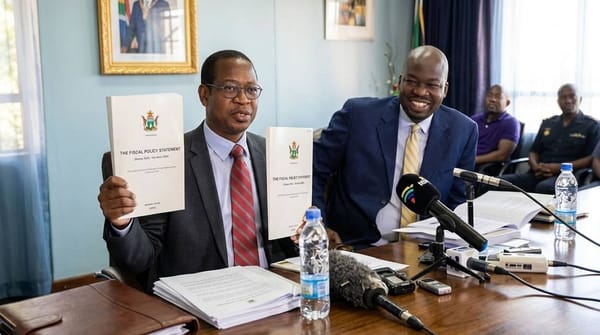
The fiscal reckoning is not theoretical. Zimbabwe's 2026 National Budget projected energy commodity indices falling by 6 percent. It assumed Brent averaging 60 dollars. The budget allocated on that basis. Every expenditure line downstream of fuel — transport, agriculture, power generation, manufacturing inputs — is now mispriced. The same logic applies across the continent. Budgets are political documents that embed assumptions about the world. When the world changes this fast, the budget becomes a record of what the government believed three months ago, not a guide to what it can afford today.
The corrective instruments are limited and unattractive. Governments can absorb the shock through subsidies, which widens deficits at a moment when 40 percent of African countries are already in or near debt distress. They can pass through the price, which accelerates inflation and erodes the purchasing power of the populations least able to bear it. They can draw down foreign reserves, which weakens currency positions already under pressure. Or they can reform — fast-tracking domestic refining capacity, rehabilitating dormant pipeline infrastructure like Zimbabwe's Feruka line from Mutare to Harare, reducing the tax burden on fuel to close the gap with regional competitors, and investing in the renewable energy alternatives that would structurally reduce exposure to exactly this kind of shock.
Markets do not reward denial. They reward adjustment. The finance ministries that acknowledge the new price reality this month — that issue supplementary budget statements, revise import cover projections, and communicate credibly to bondholders and multilateral partners — will preserve institutional credibility. Those that wait, hoping the strait reopens before the fiscal year unravels, are betting the budget on a war they cannot influence.
Oil shocks do not announce their duration. They announce their arrival. This one has arrived.