CAF Appeal Board Awards Morocco AFCON 2025 Title After Senegal Forfeit
Patrice Motsepe's AFCON Earthquake: How CAF Stripped Senegal of a Trophy They Won on the Pitch. CAF has done what no football body has done before: stripped a champion of a title won in extra time and handed it to the host nation by boardroom forfeit. Senegal is heading to CAS.

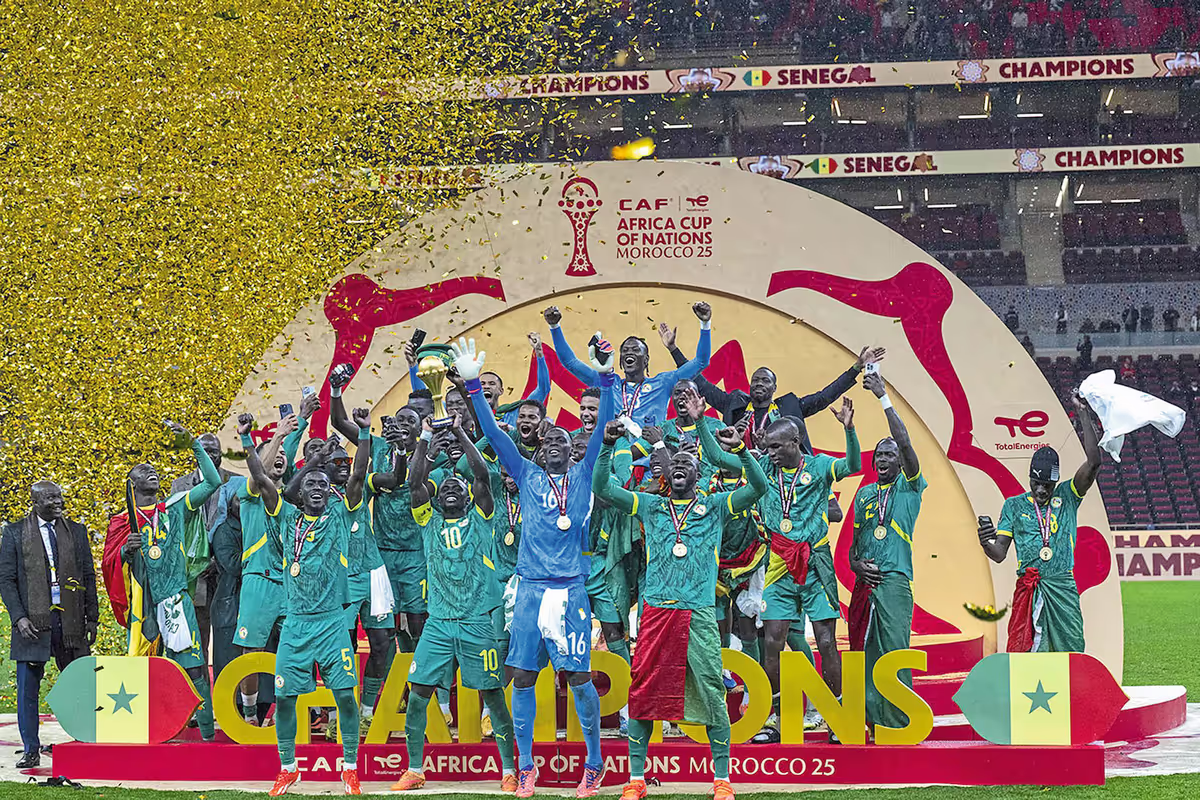
Part 1. The Scoreline That No Longer Exists
On 9 February 2025, Senegal beat Morocco 1-0 after extra time in Rabat to win AFCON 2025. The Teranga Lions lifted the trophy on Moroccan soil, in front of a Moroccan crowd, having survived 120 minutes of football that included a disputed penalty, a disallowed goal, and a brief player walkoff that would later become the most consequential two minutes in African football history.
That result no longer stands.
On 17 March 2026, CAF's Appeal Board declared the final a forfeit. The official scoreline is now Morocco 3, Senegal 0. The host nation has been retroactively crowned African champions for the first time since 1976. Senegal's second continental title has been erased from the record books.
For the first time in the 67-year history of AFCON, the champion has been decided not by a referee's whistle but by a legal panel sitting in a conference room, two months after the final.
Part 2. The Walk-Off That Broke the Lock
The facts are not in dispute. Late in the final, after a sequence of refereeing decisions that Senegal's players considered unjust, the squad walked off the pitch in protest. The interruption was brief. They returned. The match resumed. Senegal won.
But under Article 82 of CAF's AFCON Regulations, a team that refuses to play or abandons the field — even temporarily — commits a sanctionable offence. Under Article 84, the sanction includes forfeiture, recorded as a 3-0 loss.
Morocco's Royal Football Federation lodged a formal appeal immediately after the final, arguing that the walk-off constituted abandonment and that the result should be annulled. CAF's Disciplinary Board initially disagreed, allowing Senegal's 1-0 victory to stand. Morocco appealed again. This time, the Appeal Board overruled the Disciplinary Board, declared the appeal admissible, and reversed the result.
Two different CAF panels looked at the same facts and reached opposite conclusions. That is the institutional story nobody wants to talk about.
Part 3. The Numbers on the Table
The scale of what just happened deserves a clean look.
Senegal played seven matches across the tournament. They scored 14 goals. They conceded three. They beat Morocco on Moroccan soil in extra time. None of that matters now.
Morocco played seven matches. They scored 12 goals. They conceded four, including the final. They lost the match that has now been recorded as a 3-0 win.
The walk-off lasted a matter of minutes. The appeal process lasted two months. The consequence is permanent.
On the pitch: Senegal 1, Morocco 0. In the boardroom: Morocco 3, Senegal 0. At CAS: pending.
Part 4. Motsepe's Dilemma
Patrice Motsepe is the president of CAF. He is South African, billionaire class, with the kind of political dexterity that allowed him to ascend to the top of African football governance without making a single public enemy on the way up. His presidency has been defined by careful diplomacy and revenue growth. This ruling tests both.
The optics are brutal. A host nation that lost on the pitch has been awarded the title off it. The decision was made not by the initial panel that reviewed the case but by a second panel that overruled the first. The beneficiary is Morocco, one of CAF's most powerful member federations and the host of the 2030 FIFA World Cup. The loser is Senegal, whose football federation has historically carried less institutional weight within CAF's corridors.
Motsepe did not personally make this ruling. CAF's judicial bodies are structurally independent. But in African politics, the man at the top always owns the outcome. Motsepe now faces a choice every institutional leader dreads: defend a legally sound but publicly toxic decision, or signal distance from it and undermine the body he oversees.
Selectorate theory explains this cleanly. Motsepe's winning coalition within CAF includes Morocco, Egypt, and the North African bloc that delivers votes, hosting bids, and broadcast revenue. It also includes West Africa, which delivers player talent, fan numbers, and political noise. This ruling has pleased one side and enraged the other. The coalition mathematics have shifted.
Part 5. Dakar's Fury and the Road to Lausanne
The Senegalese Football Federation has called the ruling a travesty. That is the diplomatic version of what is being said in Dakar.
FSF president Augustin Senghor has announced an immediate appeal to the Court of Arbitration for Sport in Lausanne. The legal arguments will likely centre on three fronts. First, proportionality — whether stripping a title for a brief walkoff is a sanction proportionate to the offence. Second, procedural fairness — whether the Appeal Board's reversal of the Disciplinary Board followed due process. Third, the interpretation of Article 82 itself — whether a temporary interruption that ended with the team returning to complete the match constitutes abandonment under the regulation.
CAS cases take months. In the meantime, the record books read Morocco. The trophy is in Rabat. And every Senegalese footballer who played in that final has a winner's medal that may or may not mean anything by December.
The political dimension is equally sharp. In a country where football and national pride are inseparable, this ruling is not a sporting story. It is a sovereignty story. Senegalese media is framing it as an institutional betrayal. Social media across Francophone West Africa is treating it as evidence that CAF's governance serves North African interests at the expense of sub-Saharan nations. Whether that narrative is fair is almost irrelevant. It is now the dominant frame.
Part 6. The Precedent That Changes Everything
Before this ruling, walk-offs in African football were treated as disciplinary matters. Fines. Suspensions. Points deductions at worst. No federation, no coach, no player had reason to believe that a brief on-pitch protest could cost an entire tournament title months after the event.
That calculation has now been rewritten.
Every national team coach on the continent now knows that if players leave the pitch — for any reason, for any duration — the result is vulnerable. Every federation now knows that a rival can lodge a post-match appeal and potentially flip an outcome weeks or months later. The walk-off is no longer a protest tool. It is a legal tripwire.
For referees, this creates a paradox. If match officials know that a walk-off triggers an automatic forfeit clause, the incentive structure around controversial decisions shifts. A referee who makes a bad call and sees the opposition walk off may have just handed the match to the other team regardless of what happens on the pitch. The regulation designed to prevent disruption may end up encouraging gamesmanship around it.
FIFA has not commented on the ruling. But if CAS upholds it, the precedent extends beyond Africa. Every confederation in the world will have to reckon with whether their regulations contain the same tripwire — and whether a team that walks off for 90 seconds in a World Cup final could lose the trophy two months later.
Part 7. What This Tells Africa About Its Own Institutions
Strip the football away. What remains is a governance story that every African institution should study.
A decision was made by one panel. A second panel reversed it. The reversal benefited the most powerful party. The timing allowed no real-time remedy. The process was opaque enough that reasonable people can disagree about whether it was fair. The losing party has to spend six figures appealing to a court in Switzerland because it does not trust the continental body to police itself.
Replace CAF with any African regulatory authority. Replace Senegal with any smaller member state. Replace Morocco with any dominant economic power within a regional bloc. The pattern holds. The lesson is not that the ruling was wrong. The ruling may well be legally correct. The lesson is that a legally correct outcome delivered through a process that looks compromised will never be accepted.
Frederic Bastiat, the economist, wrote that the worst thing a government can do is make the right decision in the wrong way, because it teaches citizens to distrust even the good decisions that follow. CAF has just taught 1.4 billion Africans that the biggest trophy on the continent can be reassigned in a conference room, months after the match, by a panel that overruled its own colleagues. Even if the law supports it, the institution has taken damage that no appeal board can reverse.
Part 8. The Verdict
Senegal won AFCON 2025 on the pitch. Morocco now holds the title in the record books. CAS will decide which version of history survives. But the real loser is already clear.
CAF entered this crisis as the governing body of the most passionate football continent on Earth. It exits as an institution that two of its most important member federations do not trust to deliver a final result. Motsepe's challenge is no longer about broadcasting deals or World Cup qualifying formats. It is about whether the 54 nations that submit to CAF's authority believe that authority is exercised fairly.
In Dakar, the response is fury. In Rabat, the celebration comes with an asterisk that will take decades to fade. In Lausanne, the lawyers are already billing. And across the continent, every football fan who watched that final in January now knows something they did not know before.
In African football, as in African politics, the final whistle is not the final word.