Free the ZiG? The Most Dangerous Debate in Zimbabwe's Economy
Every successful currency has a moment where its creators must decide whether to trust it. Not trust it the way a central banker trusts it, with reserve ratios and monetary policy statements. Trust it the way a parent trusts a child to walk without holding their hand.

The ZiG has arrived at that moment, and the argument over what happens next is the most consequential economic debate in Zimbabwe since dollarisation.
On one side, economist Eddie Cross published a blistering critique this week calling for the Reserve Bank to free the ZiG market. Cut the 35 percent policy rate. Let the exchange rate find its own level. Stop strangling domestic credit in order to maintain a stability that is increasingly artificial. On the other side, the RBZ under Governor Mushayavanhu is holding the line. The rate stays. The managed float continues. New ZiG banknotes, the 100 and 200 denominations, enter circulation on April 7. Banking fee reforms take effect April 1. The message is clear: we built this, it is working, do not touch the architecture.
Both sides have the data to support their case. And that is precisely what makes this dangerous.
The case for the RBZ
The numbers are extraordinary by any historical Zimbabwean standard.
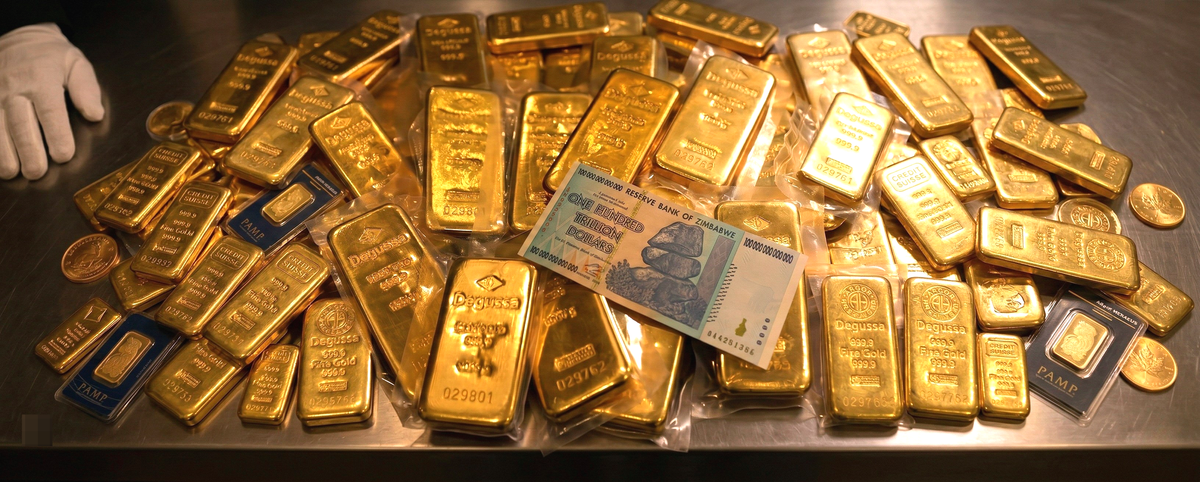
The ZiG has depreciated only 3.89 percent against the US dollar in 12 months. For a country that has destroyed four currencies since 2008, that sentence alone deserves a moment of silence. Annual ZiG inflation hit 3.8 percent in February, the first single-digit reading since 1997. Foreign reserves backing the currency have surged from $276 million at launch in April 2024 to $1.2 billion by December 2025, a 335 percent increase. The IMF has just signed a Staff-Monitored Program. The EU has lifted individual sanctions. Gold at $5,100 an ounce is flooding reserves with hard backing.
By the RBZ's own logic, the 35 percent rate is not a flaw. It is the foundation. High rates crushed speculative borrowing in ZiG, eliminated the carry trade that destroyed previous currencies, and forced the economy to price in genuine scarcity. The managed exchange rate prevented the wild swings that would have killed confidence before it could take root. And it worked. Sixteen months of stability is not a talking point. It is a track record no Zimbabwean currency has matched in three decades.
The new banknotes are a calculated confidence signal. Higher denominations mean the RBZ believes the currency will hold its value long enough for a ZiG 200 note to remain useful. The banking fee reforms, scrapping account service charges, capping POS fees at 1.5 percent, eliminating minimum transaction charges, are designed to push more transactions onto digital ZiG rails, increasing velocity and acceptance without printing money. It is a supply-side approach to currency adoption, and it is more sophisticated than anything the RBZ has attempted before.
The case for Eddie Cross
Cross is not an opposition polemicist. He is a former parliamentarian, a Reserve Bank advisory board member, and arguably the most credible independent economic voice in Zimbabwe. When he says the ZiG market needs to be freed, the rooms where fiscal policy is made go quiet.
His argument is structural. A 35 percent interest rate does not just stabilise a currency. It kills productive investment. No manufacturer borrows at 35 percent to build a factory. No farmer borrows at 35 percent to expand irrigation. No small business borrows at 35 percent to hire staff. The rate has succeeded in its primary objective, stability, but it has done so by freezing the economy beneath the surface. Zimbabwe's consumer-facing businesses are dying. OK Zimbabwe, one of the most recognisable retail brands in the country, has entered voluntary corporate rescue. That is not a coincidence. It is a consequence.
Cross estimates the real economy, including informal markets and unrecorded trade, could be worth over $100 billion, far above official GDP. If true, the formal financial system operating under 35 percent rates is serving a fraction of the actual economy. The rest operates in USD, outside the banking system, beyond the reach of monetary policy entirely. The ZiG's stability is real, but it is the stability of a currency that most of the economy has simply chosen to ignore.
His most provocative claim concerns gold. Cross argues that actual gold production significantly exceeds the official 46.7 tonnes, with the difference smuggled out through informal channels. If the formal economy captured even half of that leakage, the reserves backing the ZiG would be so overwhelming that the currency could withstand a market-determined exchange rate without collapsing. The RBZ is protecting the ZiG from a market shock it may not need to fear.
The political architecture beneath the economics
This is where the debate stops being about interest rates and starts being about who the economy is designed to serve.
A managed exchange rate with a 30 percent ZiG retention requirement on large exporters is not neutral. It is a mechanism. Exporters earn dollars. They surrender 30 percent at the official rate, approximately 25.6 ZiG per dollar. If the market rate is higher, as it invariably is, that gap represents a transfer of value from the productive economy to the institutions that administer the exchange. Who runs those institutions, who allocates the captured forex, and whose imports get priority at the official rate are not economic questions. They are questions of political organisation.
Freeing the ZiG would close that gap. A market-determined exchange rate means exporters keep what they earn at the price the market assigns. The implicit subsidy disappears. The ability to allocate forex preferentially disappears. The entire machinery of managed scarcity, which is also the machinery of patronage, comes under threat.
This is why the debate is dangerous. Not because either side is wrong about the economics. Both are defensible. It is dangerous because the economic choice maps directly onto a political choice about the distribution of Zimbabwe's commodity windfall. And that choice will not be made by economists.
The question that matters
The RBZ is rolling out new banknotes on April 7. Banking reforms land on April 1. The IMF program demands continued monetary discipline. The signals all point toward continuity. The 35 percent rate will hold through mid-2026 at minimum.
But the pressure is building from both directions. From below, consumer businesses are suffocating. OK Zimbabwe is the headline, but dozens of smaller retailers and manufacturers are in the same distress without the name recognition to make the news. From above, the gold windfall is generating so much revenue that the case for easing becomes harder to reject. If your reserves have grown 335 percent in 16 months, what exactly are you still afraid of?
The honest answer is that the RBZ is not afraid of the market. It is afraid of what happened last time. And the time before that. And the time before that. Four destroyed currencies create institutional trauma that no amount of reserve accumulation fully heals. The 35 percent rate is not just a monetary tool. It is a scar.
Whether Zimbabwe can move past that scar, whether it can graduate from stability through suppression to stability through confidence, is the test that defines the ZiG experiment. Eddie Cross says the patient is ready to walk. The RBZ says keep the crutches one more year. The patient, meanwhile, is watching OK Zimbabwe collapse and wondering whether stability that cannot feed a nation is stability at all.
Until Next Time, Head Bowed