From Hyperinflation to IMF Deal: How Zimbabwe Rewrote Its Economic Story in 18 Months
In January 2026, Zimbabwe recorded an annual inflation rate of 4.1 percent. By February, it dropped to 3.8 percent. For a country that once printed hundred-trillion-dollar banknotes, this is not just a statistic. It is a statement.


Eighteen months ago, Zimbabwe was coming off a drought-ravaged 1.7 percent growth year with a brand-new currency that had lost half its value and no formal relationship with the IMF. Today, it has single-digit inflation for the first time in a generation, a gold-backed currency that is holding, an IMF staff-monitored programme that opens the door to debt resolution, record mineral production, and nearly a billion dollars in committed Chinese lithium processing investment. This is not the Zimbabwe of the headlines. This is the Zimbabwe of the data
Part 1 — The Number That Changed Everything
In January 2026, Zimbabwe recorded an annual inflation rate of 4.1 percent. That is not a typo. Four point one percent. For a country that once printed hundred-trillion-dollar banknotes, a country where inflation hit 231 million percent in 2008, a country that has been the global poster child for monetary collapse for two decades, this number is not just a statistic. It is a statement.
By February 2026, that number dropped further to 3.8 percent. Monthly inflation stood at 0.1 percent. Food prices actually fell. This is the lowest inflation Zimbabwe has recorded since 1997. Almost thirty years.
And it is not a fluke. It is the result of a deliberate, sustained, and measurable policy programme that has been running since late 2024. The question is no longer whether Zimbabwe can stabilise. The question is whether the rest of the world is paying attention.
Part 2 — The Architecture of Stabilisation
What changed? Three things, all operating simultaneously.
First, monetary policy. The Reserve Bank of Zimbabwe under Governor John Mushayavanhu implemented one of the most aggressive monetary tightening programmes on the continent. Money supply growth was slashed from over 100 percent to below 1 percent. Interest rates were pushed to around 35 percent, choking speculative borrowing and draining liquidity from the parallel market. The result was a currency that stopped moving sideways every week.
Second, the Zimbabwe Gold currency. The ZiG, launched in April 2024 as the country's sixth attempt at a stable local currency since 2008, has now survived longer and performed better than any of its predecessors. The Reserve Bank accumulated over 1.1 billion dollars in foreign exchange reserves by mid-December 2025, up from just 276 million dollars when the ZiG was introduced. The currency is backed by 2.5 tonnes of gold. And in March 2026, the RBZ introduced new higher-denomination ZiG100 and ZiG200 notes, a signal that the central bank is confident enough to push deeper into de-dollarisation.
Third, fiscal discipline. Government revenues strengthened through improved tax administration and new collection measures, narrowing the deficit and producing a small primary surplus. The 2026 revenue target stands at approximately 9.4 billion dollars, a 17 percent increase from the 2025 target of 7.57 billion. The strategy is straightforward. Widen the tax base. Leverage technology for collection efficiency. Fund infrastructure from domestic resources rather than waiting for external borrowing that cannot come until arrears are cleared.
These three pillars are not operating in isolation. They are reinforcing each other. Tight money supports the currency. A stable currency supports disinflation. Lower inflation supports fiscal planning. Fiscal discipline supports credibility. Credibility supports the next step.
Part 3 — The IMF Handshake
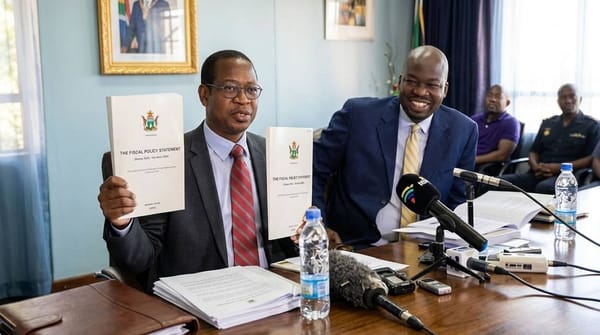
On February 6, 2026, Zimbabwe and the International Monetary Fund reached a staff-level agreement on a 10-month Staff-Monitored Programme. This is the single most important institutional development in Zimbabwe's international economic relations in over a decade.
To understand why, you need to understand what an SMP is and what it is not. It is not a loan. It is not a bailout. It does not involve any disbursement of funds. It does not carry the endorsement of the IMF's Executive Board. What it does is create a formal framework for the IMF to monitor Zimbabwe's economic reforms against agreed benchmarks. It creates a track record. And that track record is the key that unlocks everything else.
Zimbabwe has been accumulating external arrears to official creditors since the early 2000s. Those arrears stand at approximately 7.4 billion dollars. The IMF cannot give Zimbabwe a funded programme until those arrears are cleared. The World Bank and other multilateral lenders follow the IMF's lead. Without arrears clearance, Zimbabwe remains locked out of concessional financing, which means no cheap international capital for infrastructure, no budget support, and no access to the global financial architecture that every developing economy needs.
The SMP is the bridge. George Guvamatanga, Permanent Secretary in the Ministry of Finance, told Reuters that the programme is designed to consolidate current fiscal and monetary policy reforms. The IMF's mission chief Wojciech Maliszewski said it is intended to establish a credible track record that supports re-engagement efforts and lays the groundwork for substantive discussions on arrears clearance and debt restructuring.
The last time Zimbabwe attempted an SMP was between May 2019 and May 2020. It was abandoned after the country failed to adhere to the Fund's recommendations. This time, the macroeconomic backdrop is fundamentally different. Inflation is in single digits. The currency is holding. Revenue is growing. The fiscal deficit is narrowing. The conditions that destroyed the 2019 attempt are not present today.
Part 4 — The Growth Engine
The IMF projects Zimbabwe's economy will grow at approximately 5 percent in 2026. The World Bank's Zimbabwe Economic Update puts the same figure at 5 percent. The government's own target is significantly more ambitious at 8.5 percent. Even taking the conservative external estimates, 5 percent growth places Zimbabwe well above the projected global growth rate of 2.6 percent and broadly in line with the fastest-growing economies in Sub-Saharan Africa.
This growth is not theoretical. It is being driven by two sectors that are physically producing and exporting at scale.
Gold. Zimbabwe produced a record 46.7 tonnes of gold in 2025. Export revenues from gold surpassed 4 billion dollars, accounting for more than 50 percent of total exports and nearly 60 percent of foreign currency inflows. Gold is not just an export commodity in Zimbabwe. It is the foundation of the entire monetary system. Every ZiG note in circulation is backed by gold and foreign reserves held at the central bank. With gold prices reaching over 5,100 dollars per ounce in January 2026 and analysts forecasting possible peaks above 6,000 dollars this year, Zimbabwe's gold-backed currency strategy is being validated by the market itself.
Caledonia Mining is investing 132 million dollars this year alone as part of a 584-million-dollar programme to develop the Bilboes Gold Mine, projected to become the country's largest. This is not speculative capital. This is committed infrastructure spend with a production timeline through 2028.
Agriculture. The 2024-25 season delivered a strong recovery from the El Nino drought that hammered output in 2024. Tobacco, maize, and other crops bounced back. The IMF specifically cited agriculture as one of the two pillars driving the 2025 growth performance that surpassed the initial 6.6 percent projection.
Mining beyond gold. Lithium has become Zimbabwe's strategic mineral play. The country holds Africa's largest lithium reserves. In 2025, Zimbabwe exported over 1.1 million metric tonnes of lithium-bearing spodumene concentrate, up 11 percent from the previous year. Chinese firms have deployed nearly 1 billion dollars in lithium processing investment, including Huayou Cobalt's 400-million-dollar lithium sulphate plant and Sinomine's planned 500-million-dollar facility at Bikita.
And then on February 25, 2026, the government made its boldest resource sovereignty move yet. The Mines Ministry announced an immediate ban on exports of all raw minerals and lithium concentrates. The ban was originally scheduled for January 2027 but was accelerated by ten months. The message is clear. Zimbabwe will no longer be a quarry. If you want the minerals, you process them here.
Part 5 — The Debt Question
The elephant in every room when discussing Zimbabwe's economy is the debt. Total external debt stands at approximately 21 billion dollars, including 7.4 billion in arrears to official creditors. This debt burden is classified as unsustainable and in distress. The debt-to-GDP ratio, while declining from 72.9 percent in 2024 to a projected 49.5 percent in 2025, remains a structural constraint on the country's ability to access international capital markets.
The SMP is the government's answer to this problem. Not by pretending the debt does not exist, but by building the institutional credibility required to negotiate a restructuring. The programme requires the Mutapa Investment Fund, the sovereign wealth vehicle that manages state-owned enterprises, to publish audited financial statements and to refrain from contracting new debt without written approval from the Ministry of Finance. This is governance reform with teeth.
The legal architecture is also being assembled. Kepler-Karst Law Firm, Zimbabwe's legal adviser on the debt file, described the SMP agreement as a critical step toward arrears clearance and debt resolution. The pathway is emerging. Demonstrate fiscal discipline. Build a track record with the IMF. Use that track record to open negotiations with bilateral and multilateral creditors. Clear the arrears. Unlock concessional financing. Refinance the debt on sustainable terms.
This is a multi-year process. But for the first time in over two decades, the process has formally begun.
Part 6 — The Risks Nobody Should Ignore
This article would not be honest if it did not name the risks.
Power. Zimbabwe's peak electricity demand is 1,900 megawatts against generation capacity of approximately 1,200 megawatts. The deficit exceeds 1,000 megawatts. Kariba Dam is operating at 185 megawatts out of a 1,050-megawatt capacity. Until the power gap is closed, every mining operation, every processing plant, and every manufacturing facility operates under constraint. The Dangote Group's 1-billion-dollar energy and infrastructure agreement signed in November 2025 and the Invictus Energy gas exploration at Mukuyu are promising, but they are not yet producing electrons.
Informality. Approximately 60 percent of Zimbabwe's economic activity occurs in the informal sector. This is not captured in GDP statistics, not fully reached by tax collection, and not covered by social protection. World Economics estimates Zimbabwe's true GDP at 126 billion dollars in PPP terms for 2026, a figure 91 percent higher than the World Bank's official estimate. The gap between what the economy actually produces and what the formal system captures is enormous.
Debt sustainability. Even with the SMP, Zimbabwe's fiscal financing gaps are projected at approximately 1.25 percent of GDP in 2025 and 2026. External arrears are not shrinking by themselves. The window between building credibility and actually clearing debt is measured in years, and the political patience required to maintain tight fiscal and monetary policy during that window cannot be taken for granted.
Climate. Zimbabwe is one of the most climate-exposed economies in Sub-Saharan Africa. The 2024 drought cut growth from over 5 percent to 1.7 percent in a single year. One bad rainy season can undo twelve months of macroeconomic progress.
These are not reasons to dismiss the story. They are reasons to understand its fragility. The macroeconomic stabilisation is real. But it is young. It needs protection, consistency, and time.
Part 7 — What the Scoreboard Says
Here is the economic dashboard as of March 2026.
GDP growth 2025: approximately 6.6 percent, surpassing the initial forecast. GDP growth 2026 forecast: 5 percent (IMF and World Bank), 8.5 percent (government target). Inflation: 3.8 percent annual as of February 2026, the lowest since 1997. Monthly inflation: 0.1 percent. Gold production 2025: 46.7 tonnes, a national record, generating over 4 billion dollars in export revenue. Lithium exports 2025: over 1.1 million metric tonnes of spodumene concentrate. Foreign exchange reserves: 1.1 billion dollars as of December 2025. IMF Staff-Monitored Programme: agreed February 6, 2026, ten months duration. Revenue target 2026: 9.4 billion dollars. External debt: approximately 21 billion dollars including 7.4 billion in arrears.
Read those numbers together. Not one at a time. Together. This is a country that is growing faster than the global average, has inflation lower than the United States, is producing gold at record levels, has secured its first formal IMF engagement in years, and is building the institutional architecture to eventually clear its debt and rejoin the international financial system.
The narrative about Zimbabwe has not caught up with the data. It will.
Part 8 — The Verdict
Eighteen months ago, Zimbabwe was coming off a drought-ravaged 1.7 percent growth year with a brand-new currency that had lost half its value and no formal relationship with the IMF. Today, it has single-digit inflation for the first time in a generation, a gold-backed currency that is holding, an IMF staff-monitored programme that opens the door to debt resolution, record mineral production, and nearly a billion dollars in committed Chinese lithium processing investment.
This is not the Zimbabwe of the headlines. This is the Zimbabwe of the data.
The stabilisation is real. The growth is real. The risks are real. And the opportunity, if policy discipline holds, if the power gap closes, if the rains come, and if the IMF track record is maintained, is the most significant economic opening Zimbabwe has had since independence.
The world has spent twenty years telling the Zimbabwe story as a cautionary tale. The 2026 data tells a different story. Whether it becomes the permanent story depends on what happens in the next eighteen months.
But the trajectory is set. And the numbers do not lie.