Ireland Is Quietly Becoming Zimbabwe's Most Important European Partner. Here Is Why Machakaire's Meeting With Ambassador Gormley Changes the Game.
Ireland and Zimbabwe are deepening a 46-year development partnership at the exact moment EU sanctions have been dismantled and Sweden is pulling out. Minister Machakaire and Ambassador Gormley just signalled what comes next.

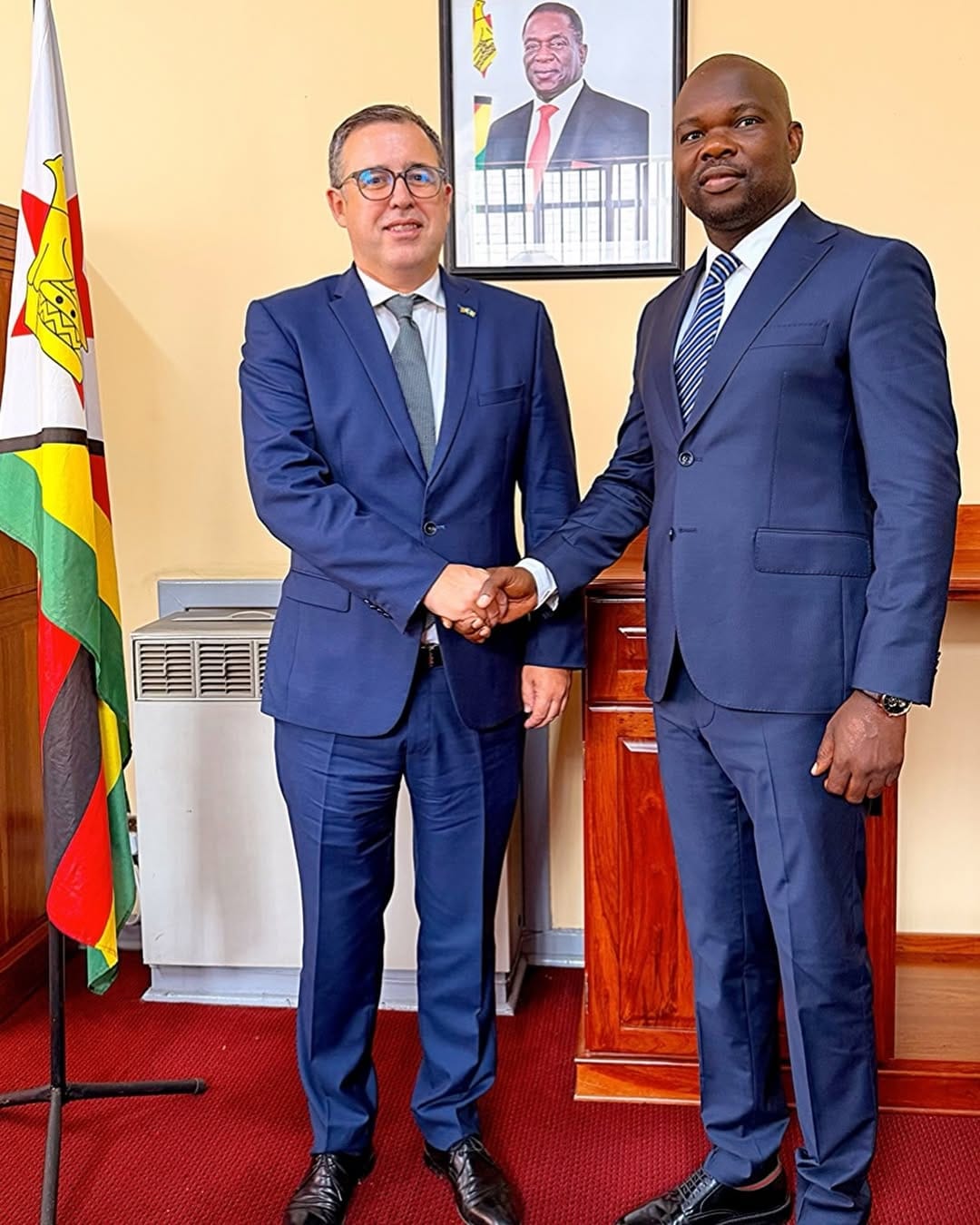
Ireland and Zimbabwe just took a 46-year relationship into its most consequential phase. Minister of Youth Empowerment, Development and Vocational Training Tino Machakaire hosted Irish Ambassador to Zimbabwe Austin Gormley for a courtesy call at the Ministry offices this week, with discussions centred on youth empowerment and development. The meeting reads as protocol. The timing makes it strategy.
The diplomatic context surrounding this courtesy call has shifted more dramatically in the past 12 months than at any point since 2002. In February 2026, the EU Council lifted all travel bans and asset freezes on Zimbabwean individuals and entities, retaining only the arms embargo. The UK cleared its Zimbabwe sanctions list entirely in May 2025. Sweden, which has partnered with Zimbabwe on development since independence, announced in December 2025 that it will close its Harare embassy by August 2026 and phase out its bilateral programme. Ireland, by contrast, is expanding.
This is not coincidence. It is a structural shift in Zimbabwe's European partnership landscape, and Machakaire is positioning his ministry at the centre of it.
Why Ireland matters more than its size suggests
Ireland is a country of 5.3 million people with an outsized footprint in African development. Its total overseas development assistance reached 2.35 billion euros in 2024, representing 0.56 per cent of GNI. Dublin is one of the few OECD capitals increasing aid budgets while the United States, United Kingdom, Germany, and France are cutting theirs. Ireland ranks second globally on the Principled Aid Index. In January 2026, the government announced 100 million euros in new funding for 10 civil society organisations operating across 45 countries, including 3 with deep roots in Zimbabwe: Trocaire, GOAL, and Oxfam Ireland.
Ireland carries no colonial history in Africa. Its engagement is shaped instead by its own experience of famine, colonisation, and post-colonial nation-building. Irish missionaries were active in Zimbabwe well before independence in 1980, the same year Irish Aid began development cooperation in the country. Ambassador Gormley referenced this directly when he presented his credentials to President Emmerson Mnangagwa in July 2024, noting the strong Irish imprint through missionary work and invoking Father Paschal Slevin, an Irish priest posthumously awarded the Royal Order of Munhumutapa during the Mugabe era.
For a government pursuing re-engagement with the West under the mantra of being a friend to all and an enemy to none, Ireland offers something rare: a European partner with EU membership, development credibility, and zero baggage.
The man Ireland is talking to
Machakaire is not a ceremonial minister. Appointed to the full ministerial portfolio by President Mnangagwa in September 2023, the 44-year-old ZANU-PF Politburo Secretary for Youth Affairs has built one of the most active records in Cabinet on youth programming.
In March 2025, he launched the Presidential Youth Empowerment Scheme, a 17 million dollar package comprising a 2 million dollar revolving fund through EmpowerBank, 10 million dollars earmarked for youth in agriculture, and 5 million dollars for artisanal mining equipment. He drove Cabinet approval of the National Youth Empowerment Strategy 2026 to 2030, formally launched in October 2025, targeting 2.3 million young people across 5 pillars. He oversaw the relaunch of the Youth Service programme, with a target of training 100,000 over 5 years and a 2025 Cabinet directive making Youth Service certification a precondition for civil service entry. The Marondera Youth Service and Vocational Training Centre, the largest facility of its kind, was commissioned in February 2026 on National Youth Day.
This is the minister Ireland chose to engage bilaterally on youth empowerment. The alignment is deliberate. Irish Aid already funds vocational training and skills development for women and young people in Zimbabwe. The Ireland Fellows Programme sends early-to-mid-career Zimbabwean professionals to Irish universities for fully funded master's degrees. Trocaire operates across 6 provinces with 26 local partner organisations. GOAL has maintained 60 staff in Harare and Manicaland since 2002.
The numbers that make this urgent
Zimbabwe's median age is 19.2 years. Approximately 62 per cent of the population is under 25. An estimated 5.4 million young people fall within the 15 to 35 age bracket. The International Labour Organisation puts youth unemployment at 15.55 per cent under the narrow definition, but the structural picture is far worse. ZimStat data from 2022 shows 2.3 million youth classified as NEET, meaning not in education, employment, or training. The Borgen Project estimates 47.6 per cent of those aged 15 to 24 are NEET. Afrobarometer's June 2024 survey found that unemployment is the number one policy priority for Zimbabweans.
The institutional infrastructure exists but is starved of resources. Sixty vocational training centres operate nationwide, but enrol only around 9,500 students against estimated demand of 130,000. A March 2026 parliamentary report revealed that Treasury disbursed just 4,884 dollars per VTC per year in 2024, a figure described as grossly inadequate. Average student fees of 500 dollars per term are prohibitive for most families.
This is the gap that international partnerships are designed to fill. And Ireland, unlike Sweden, is not leaving.
The vacuum and the opportunity
Sweden's withdrawal from Zimbabwe creates a measurable hole. Stockholm ran a 6.3 million dollar programme with MercyCorps specifically targeting income improvement for women and youth in the informal sector. That programme now faces an expiration date. The Netherlands maintains an active embassy with a 2023 to 2026 strategy prioritising women and youth employability, but faces its own political headwinds around the PVO Act. Denmark funds a youth active citizenship programme linking Zimbabwe and Kenya but at modest scale.
Ireland occupies a distinctive space. It combines Nordic-style development credibility with EU membership. It has an existing aid infrastructure in Zimbabwe. Its ambassador has presented credentials to the President and publicly expressed interest in increasing economic ties and trade. Its Africa strategy, Global Ireland 2025 and its successor Global Ireland 2040, explicitly commits to doubling the scope and impact of engagement on the continent. Dublin opened new embassies in Morocco and Senegal in recent years, expanding to 14 missions across Africa.
The Ireland Fellows pipeline, the Irish NGO operational footprint, the vocational training programmes already running through Irish Aid, and the ambassador's direct engagement with the Ministry of Youth all point in the same direction. Ireland is not arriving in Zimbabwe. It has been here for 46 years. It is now choosing to go deeper at the exact moment the diplomatic penalty architecture is being dismantled and other European partners are retreating.
So what for ministers, central bankers, and CEOs
The Machakaire-Gormley meeting is a signal, not a ceremony. Zimbabwe's youth bulge is either the country's greatest asset or its most dangerous liability, and the difference comes down to whether Harare can attract external partnerships that translate into funded programmes, skills pipelines, and employment pathways.
Ireland is a credible partner because it comes with capital, institutional expertise, and political cover. A bilateral youth empowerment partnership with an EU member state that has no colonial history and is actively expanding its Africa footprint strengthens Zimbabwe's re-engagement narrative at a moment when it matters most. For the private sector, the Ireland Fellows alumni network and Irish NGO supply chains represent underexploited connective tissue between Harare and Dublin. For Treasury, Irish Aid represents development finance that arrives without the conditionality baggage of larger bilateral donors.
Machakaire understood the room. The meeting was conducted, as he noted, in the spirit of President Mnangagwa's commitment to an open-door policy and strengthened international cooperation. The question now is whether the Ministry and the Embassy move from courtesy to programme design. The 2.3 million young Zimbabweans classified as NEET are not waiting for protocol. They are waiting for pipelines.
Until Next Time, Head Bowed.