The AERC Distinguished Service Award and what it reveals about intellectual capital as political power
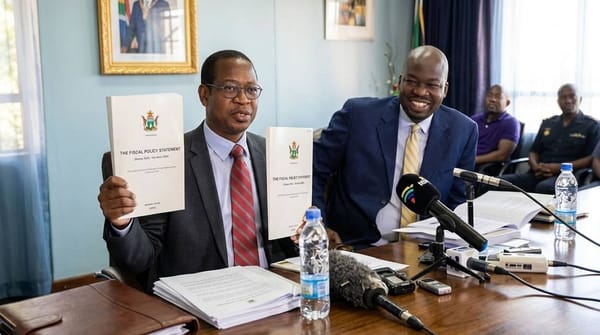
Mthuli Ncube's AERC Distinguished Service Award reveals 30 years of intellectual infrastructure that trained 4,000 economists across Africa's central banks and treasuries.


Mthuli Ncube Trained the Economists Who Now Run Africa's Central Banks — Then He Became One of Their Ministers
Most finance ministers across Africa inherited their positions through party loyalty, military proximity, or factional deal-making. Mthuli Ncube built his through 3 decades of institutional infrastructure that trained the very economists who now populate the continent's central banks, treasuries, and multilateral agencies. The African Economic Research Consortium just handed him its Distinguished Service Award. The real story is not the award. The real story is what the award reveals about how intellectual capital becomes political capital on a continent where both are scarce.
The Stakes
AERC is not a think-tank that publishes papers nobody reads. It is the single most consequential economics training pipeline in Sub-Saharan Africa. Founded in 1988, headquartered in Nairobi, legally registered in Delaware, AERC has trained over 4,000 economists at masters and doctoral level. Its graduates sit inside the Reserve Bank of Zimbabwe, the South African Reserve Bank, the Bank of Ghana, the Central Bank of Kenya, the Bank of Tanzania, and every major Bretton Woods institution operating on the continent. When any African finance minister picks up the phone and calls a central bank governor, there is a measurable probability that both of them passed through AERC programming. That is not an academic network. That is a governing infrastructure.
The Selectorate Map
In African political economy, the winning coalition is sustained through the distribution of private goods — ministerial positions, procurement contracts, land allocations, diplomatic postings. But there is a second, less visible currency that keeps coalitions intact: intellectual legitimacy. A president needs ministers who can stand in front of the IMF board and not embarrass the country. A treasury needs economists who can structure a Eurobond without external hand-holding. A central bank needs governors who can defend monetary policy in the language that Washington, London, and Beijing understand.
AERC is the factory that produces those people. And for 12 years, Ncube sat at the centre of that factory.
He joined AERC in 1992 as a Senior Researcher and Resource Person while lecturing at the London School of Economics. He joined the Board in 2004. Became Vice Chair in 2007. In 2010, he became the first African to chair the AERC Board in the organisation's 22-year history. He held the chairmanship for 2 consecutive 3-year terms until 2016.
That trajectory is worth pausing on. For 22 years, a consortium designed to build African economic capacity was chaired by non-Africans. Ncube broke that pattern. And during his tenure, the pipeline accelerated — deeper partnerships with governments, stronger connections to the AfDB, World Bank, and bilateral donors, and a research output that directly informed fiscal and monetary policy decisions across 30 countries.
The Candidates for This Kind of Influence
Who else on the continent has this combination? Count them. Ngozi Okonjo-Iweala built institutional credibility through the World Bank before becoming Nigeria's Finance Minister and now heads the WTO. Tidjane Thiam moved from McKinsey to the Ivorian national planning agency to Credit Suisse to the presidency of the PDCI. Carlos Lopes ran UNECA before advising the African Union on continental free trade. These are the people who convert intellectual infrastructure into political power. They do not campaign. They accumulate. And by the time they enter government, the network is already built.
Ncube fits this mould precisely. Before he touched a single line of the Zimbabwe national budget, he had already shaped the intellectual framework that 4,000 economists across the continent use to think about budgets. The AERC Distinguished Service Award is not a lifetime achievement plaque. It is a peer-reviewed verdict issued by the institution that watched his contribution accumulate across 3 decades.
The Scenarios
Scenario A: Zimbabwe leverages this. The AERC network becomes a soft power asset for Zimbabwean diplomacy. When Ncube walks into an AfDB board meeting or a G20 finance track session, he is not just representing Zimbabwe's $23 billion economy. He is representing a 30-year intellectual relationship with the economists who advise every government in the room. That is a form of diplomatic capital that no amount of lobbying can purchase.
Scenario B: Zimbabwe ignores this. The award gets a press release, a few social media posts, and disappears. The AERC network continues to function but Zimbabwe extracts zero strategic value from having its finance minister at the centre of it. The country continues to be perceived internationally as a fiscal pariah rather than an intellectual contributor to continental economic governance.
Scenario C: The opposition exploits the gap. If the governing coalition does not publicise and leverage Ncube's AERC credentials, the narrative vacuum gets filled by critics who frame him exclusively through the lens of ZiG volatility and austerity budgets. The intellectual biography that gives him continental authority gets buried under domestic noise.
The Defection Watch
Ncube's value to the governing coalition is not ideological loyalty. It is irreplaceability. There is no second Mthuli Ncube on the bench — no one else in ZANU-PF's orbit who carries 3 decades of pan-African institutional relationships, a London School of Economics academic record, and the trust of multilateral lenders simultaneously. That combination is the defection insurance. You do not replace a finance minister who trained the continent's central bankers with a party loyalist who cannot explain a balance of payments to the IMF.
Zimbabwe and SADC Implications
The AERC network extends deep into SADC. Economists trained through the consortium hold positions at the Reserve Bank of Malawi, the Bank of Mozambique, the Bank of Zambia, and the Bank of Botswana. South Africa's National Treasury has multiple AERC alumni in senior positions. When Zimbabwe's finance ministry engages counterparts across the region — on trade harmonisation, ZiG acceptance, debt restructuring, or SADC industrialisation targets — Ncube's AERC relationships provide a back-channel that operates below the level of formal diplomacy. That channel has a 30-year trust deposit behind it. No other finance minister in the region carries equivalent institutional equity.
The Verdict
Awards do not matter. Networks do. The AERC Distinguished Service Award is significant only because it publicly confirms what has been operating quietly for decades: Mthuli Ncube is not just Zimbabwe's finance minister. He is a node in the intellectual infrastructure that governs African economic policy. The coalition that controls Zimbabwe should understand what it holds. A finance minister with continental institutional capital is worth more than 10 ministers with factional loyalty and no international credibility. The AERC network is built. The question is whether Harare is smart enough to deploy it.