The Fuel Price You Paid Yesterday Was Only the Beginning: Inside ZERA’s $2.17 Panic
Zimbabwe’s budget assumed $60 oil. Brent is above $100. ZERA just hiked fuel prices twice in 14 days. What Treasury must do now.


Zimbabwe’s 2026 fiscal framework assumed Brent crude at $60 per barrel. On 18 March, with oil trading above $103, ZERA raised petrol to $2.17 per litre and diesel to $2.05 — the second hike in 14 days. Every macro assumption underpinning George Guvamatanga’s budget is now operating in a different price universe. The question facing Treasury is no longer whether the oil shock will arrive. It already has.
The stakes cut across every tier of decision-making in Harare. Mining, agriculture, haulage and public transport are diesel-dependent sectors that together account for more than 60% of Zimbabwe’s GDP. Fertiliser supply — a third of which transits the Strait of Hormuz — is already repricing globally, with urea jumping from $475 to $680 per metric tonne in the United States. For a country entering its planting window and relying on imported inputs, the cost chain from barrel to breadbasket is short and unforgiving. Consumers absorb the hit through higher transport fares and food prices. The Treasury absorbs it through blown expenditure assumptions and compressed fiscal space.
The visible layer is the price adjustment itself. ZERA’s notice confirms that without government intervention, diesel would have reached $2.20 per litre. The gap between the market price and the regulated price is being funded through reduced government levies — meaning Harare is choosing to sacrifice revenue to prevent social backlash. The regulator also confirmed 3 months of fuel reserves in the supply chain, and approved diesel importation by road alongside the existing pipeline and rail routes from Beira. These are not routine measures. They are contingency protocols activated in response to a supply chain that has fundamentally shifted.
The mechanism behind this shift is the effective closure of the Strait of Hormuz since 28 February 2026, following joint US-Israeli strikes on Iran that killed Supreme Leader Ali Khamenei. Iran’s retaliatory attacks across the Gulf — including strikes on Qatari gas facilities, Saudi refineries, and the Emirati port of Fujairah — have reduced tanker traffic through the strait by more than 70%. The IEA estimates global oil supply has fallen by 8 million barrels per day in March alone. Brent peaked at $126 before settling near $103. The IEA has revised its 2026 demand growth forecast down by 210,000 barrels per day. The crisis has rerouted shipping around the Cape of Good Hope, adding weeks to transit times and compounding insurance and freight costs for every African net importer.
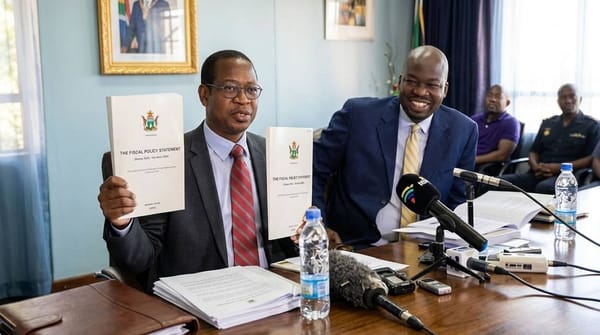
The budget Guvamatanga presented in November 2025 projected Brent at $60 per barrel for 2026, based on World Bank and IMF commodity outlooks that assumed a benign energy environment. The entire macro-fiscal framework — revenue targets, expenditure ceilings, debt service projections, inflation trajectory — was calibrated to that number. At $100-plus, every input cost rises: fuel for mining operations, transport for agricultural output, electricity generation costs, and the import bill for refined petroleum products. The budget’s own risk section acknowledged that “unanticipated global economic shocks and geopolitical tensions” posed a high-profile risk. That risk has materialised at a scale that exceeds the stress-test parameters.
COUNTRY / PRE-CRISIS PETROL (USD/L) / CURRENT OR PROJECTED / CHANGE
Zimbabwe: $1.56 to $2.17 — up 39%
South Africa: projected R2+ per litre increase in April, with Oxford Economics modelling a 0.3 percentage point growth reduction
Ethiopia: severe price shock projected — 90-95% of petroleum imports transit via Djibouti, with Gulf supply now constrained
Kenya and Ghana: Oxford Economics projects 0.3 percentage points shaved from growth under a sustained $90+ scenario
Nigeria: petrol above 1,000 naira per litre in many regions, compounded by Dangote Refinery pricing adjustments
Egypt: Suez Canal revenues under pressure as Houthi attacks resume, with the government prosecuting fuel price-gougers under emergency provisions
The moral dimension is worth stating plainly. Zimbabwe’s budget was praised for its fiscal discipline — a deficit target well below 3% of GDP, no central bank financing, a new yield curve anchored to low inflation expectations. That discipline was built for a world where oil cost $60. The Hormuz shock tests whether the framework bends or breaks. If Guvamatanga’s Treasury continues absorbing the cost differential through reduced levies, it compresses revenue. If it passes the full cost to consumers, it risks reigniting the inflation the ZiG was designed to contain. If it borrows to bridge the gap, it undermines the debt consolidation narrative. Every option has a cost. The question is who pays.
For ministers and central bankers reading this: the immediate checklist is clear. Treasury must re-forecast the macro-fiscal framework against a Brent range of $85-$110, not the $60 baseline. The Reserve Bank of Zimbabwe must assess the second-round inflation effects of consecutive fuel hikes on transport, food and input costs, and decide whether monetary policy tightening is required to anchor expectations. ZERA’s 3-month supply buffer is a credible short-term cushion, but the diversification of import routes — road alongside pipeline and rail — signals that Harare expects the disruption to persist beyond the buffer window. Mining houses and agricultural operators need diesel price assumptions revised in every Q2 operating budget. And the government’s decision to shield consumers through revenue sacrifice must be stress-tested against the revenue collection targets that underpin the entire 2026 expenditure programme.
Zimbabwe’s position carries one structural advantage that most SADC neighbours lack: gold. With precious metals near record highs — driven by the same geopolitical instability pushing oil up — Zimbabwe’s gold export revenues provide a partial offset to the oil import bill. The Budget 2026 projections already noted that gold prices would remain elevated at more than 150% above 2015-2019 averages. The Hormuz crisis has only strengthened that hedge. The policy question is whether Treasury can accelerate gold revenue conversion to fund the fuel subsidy gap without distorting the ZiG exchange rate mechanism.
The $60 world is gone. The $100 world demands a different set of decisions. The architects who built the budget now have to rebuild its load-bearing walls while the building is occupied
Until Next Time, Head Bowed.
U