The Gold-Oil Collision: Zimbabwe's $5,100 Windfall Meets the $100 Nightmare
There is a peculiar cruelty in receiving a gift and a punishment from the same event. That is exactly what the Iran-Strait of Hormuz war is doing to Zimbabwe right now.


Gold has crossed $5,100 an ounce. Brent crude has hit $100 a barrel. And Zimbabwe, sitting on the largest gold reserves in Africa while importing every drop of fuel it burns, is being pulled in two directions at once. The question is not which force wins. The question is who benefits from each one, and whether the people who benefit from the gold windfall are the same people who absorb the oil shock. They are not. And that asymmetry is the story.
The windfall nobody is discussing honestly
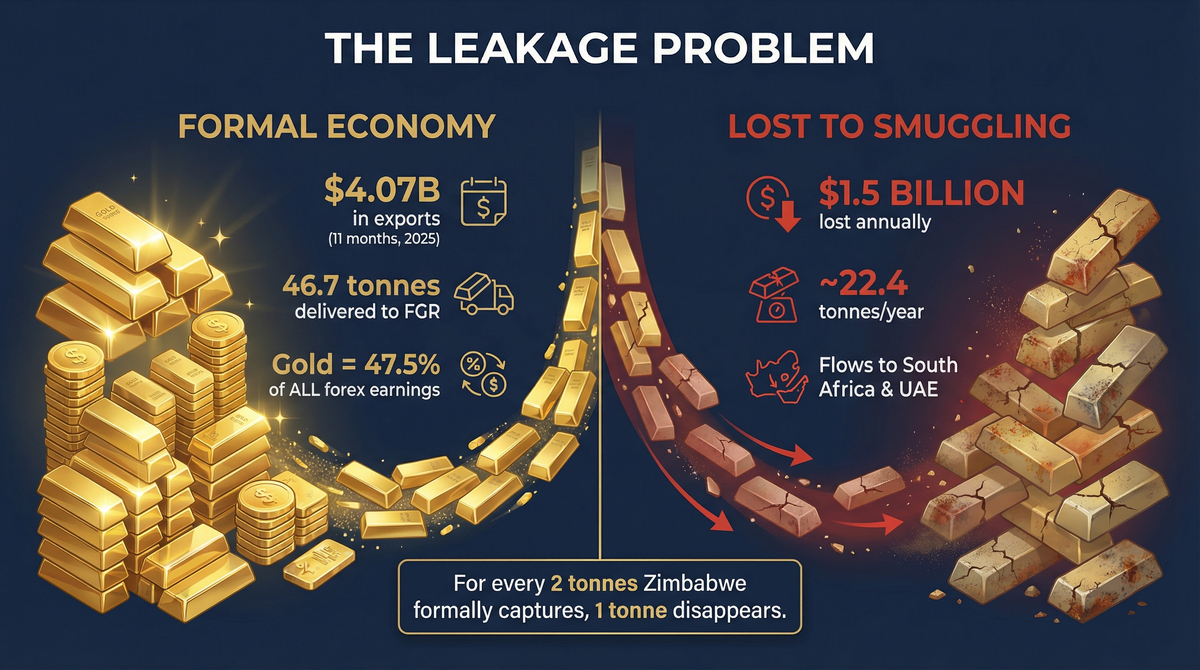
Zimbabwe produced 46.7 tonnes of gold in 2025 and exported over $4.6 billion worth of it, more than half the country's total export earnings. At $5,100 an ounce, the arithmetic is violent. Every tonne of gold Zimbabwe produces is now worth approximately $164 million. The Reserve Bank of Zimbabwe holds 2.7 tonnes in gold reserves backing the ZiG currency, and total foreign reserves have surged to $1.2 billion, a 335 percent increase since the ZiG launched in April 2024.
That is the official story. The unofficial story, which veteran economist Eddie Cross has been shouting about for weeks, is that actual production is significantly higher than 46.7 tonnes. The difference between what comes out of the ground and what arrives at Fidelity Gold Refinery is the most lucrative gap in the Zimbabwean economy. Smuggled gold is not taxed, not recorded, and not redistributed. It flows to those with the operational infrastructure to move it and the political cover to do it undisturbed.
What $5,100 gold does is make that gap wider. More valuable. More protected.
For the formal economy, record gold prices explain the headline miracle: inflation at 3.8 percent in February, the lowest in 29 years. The ZiG has depreciated only 3.89 percent against the dollar in 12 months. Foreign reserves are at their highest level in years. By every official metric, Zimbabwe's economy is performing. And gold is the engine.
But gold revenues do not arrive in Zimbabwean households as lower bread prices. They arrive as government royalties, as Mutapa Investment Fund dividends, as foreign currency retained by mining houses and their politically connected joint venture partners. The 30 percent ZiG retention requirement on large exporters means the state captures nearly a third of forex earnings at administered rates. Where that captured value goes next determines who actually benefits from the boom.
The shock everyone will feel
Oil is different. Oil is democratic in its cruelty.
When Brent crude hits $100, the fuel queue in Mbare and the logistics cost for OK Zimbabwe and the fertilizer bill for a communal farmer in Masvingo all move in the same direction. Higher. The International Energy Agency has described the Strait of Hormuz disruption as the largest supply shock in the history of the global oil market. Ten million barrels a day effectively removed. The IEA has authorized an emergency release of 400 million barrels from strategic reserves, but that is a tourniquet, not a cure.
Zimbabwe imports all of its fuel. The cost increase transmits immediately through transport, which transmits through food prices, which transmits through the consumer price index that currently reads a miraculous 3.8 percent. That number will not survive a sustained oil shock. It cannot. And the people who will feel it first are the same people who never felt the gold boom at all.
Mozambique, Zimbabwe's closest Indian Ocean corridor, has reported fuel reserves sufficient only until early May. The Mozal aluminium smelter is closing on March 15, reducing industrial demand but also signalling a broader energy crisis across the Southern African corridor. South Africa, Zimbabwe's largest trading partner, is a net fuel importer whose rand weakens with every dollar increase in the oil price. The regional transmission channels are all pointed the wrong way.
The architecture of asymmetry
Here is where the analytical lens sharpens. What Zimbabwe is experiencing is not merely a macroeconomic challenge. It is a distributional event with political architecture.
Gold revenues flow upward and inward. They concentrate in the hands of those who hold mining licenses, those who operate the refineries, those who administer the retention policies, and those who move unrecorded production across borders. These actors have USD earnings, USD savings, and USD hedges. A $100 oil price does not hurt them. They do not queue for fuel. They do not watch their margins collapse because ZUPCO fares doubled.
Oil costs flow downward and outward. They disperse across the entire population, compressing real wages, inflating food baskets, and eroding whatever purchasing power the ZiG's stability was supposed to deliver. The same monetary policy that holds the ZiG steady at 25.6 per dollar, a 35 percent interest rate, simultaneously makes it impossible for small businesses to borrow their way through the shock.
This is not corruption. It is structure. And understanding structure is more useful than outrage.
The government's position is objectively strong on the headline metrics. Five percent GDP growth projected by the IMF. Inflation at generational lows. A stable currency. A new Staff-Monitored Program with the Fund. But those headlines describe the economy of the top quintile. The OK Zimbabwe corporate rescue, one of the country's most iconic retailers entering voluntary administration, describes the economy of the other 80 percent. Both things are true simultaneously, and recognizing that duality is what separates analysis from propaganda on either side.
What to watch next
Three indicators will tell you whether the gold windfall can outrun the oil shock or whether Zimbabwe is heading for a split-screen economy.
First, the March inflation print. If CPI holds below five percent despite $100 oil, the RBZ's monetary framework is more resilient than critics claim. If it jumps above six, the disinflation narrative collapses and the political pressure to cut rates intensifies.
Second, the parallel market premium. The ZiG's official rate has been remarkably stable, but a sustained fuel price shock creates demand for USD on the parallel market to secure imports. If the premium widens beyond 15 percent, confidence erosion begins.
Third, Fidelity Gold Refinery throughput data. If official gold deliveries spike in Q1 2026 proportional to the price increase, it means the formal economy is capturing the windfall. If deliveries stay flat while the price doubles, the gap between official and actual production is growing, and the windfall is being captured off the books.
Zimbabwe has been gifted a historic commodity moment. Whether that gift reaches the people who need it most, or whether it merely fortifies the architecture that was already in place, is not a question of economics. It is a question of political choice. And in Zimbabwe, political choice has an address book.