The War You Cannot See Is Coming for Your Harvest: How Hormuz Is Starving Africa of Fertiliser
Oil at $100 is the headline. Fertiliser at 45 percent above January prices is the crisis nobody is covering. One-third of the world's seaborne fertiliser trade passes through the Strait of Hormuz. Africa imports over 90 percent of what it uses. The maths is brutal.



When oil crosses $100 a barrel, every newsroom in the world runs the same story. Pump prices. Commuter pain. Stock market volatility. The cameras point at petrol stations and trading floors. But the French economist Frederic Bastiat warned two centuries ago that the real danger in any economic shock is never what you can see. It is what you cannot.
The seen crisis is fuel. The unseen crisis is fertiliser. And for Africa, the unseen one is the one that will leave scars.
The Strait of Hormuz has been effectively closed since 28 February 2026, when the United States and Israel launched strikes on Iran. Tanker traffic through the 21-mile-wide channel has collapsed from approximately 100 vessels per day to fewer than two. Iran's Islamic Revolutionary Guard Corps has declared that not a litre of oil linked to the United States or its allies will pass. Brent crude surged from around $60 in mid-February to a peak of $126 per barrel, and has settled in the $96 to $103 range as emergency reserves absorb some of the shock. The International Energy Agency coordinated the largest strategic reserve release in history — 400 million barrels — but at current consumption rates of 105 million barrels per day, that covers less than four days of global demand. It is a tourniquet, not a cure.
But oil has a lobby. Oil has strategic reserves. Oil has the full attention of the G7. Fertiliser has none of these things.
Approximately one-third of the world's seaborne fertiliser trade passes through the Strait of Hormuz. Qatar, Saudi Arabia, Oman, and Iran are among the largest exporters of urea, a nitrogen fertiliser synthesised from natural gas. When Hormuz closes, two things happen simultaneously. Gulf fertiliser cannot reach export markets. And fertiliser producers elsewhere lose access to the natural gas and sulphur they need as feedstock. Oxford Economics has raised its fertiliser price forecast by 20 percent for the second quarter of 2026. Fitch Ratings warns that nitrogen fertiliser markets face particular exposure because 30 to 35 percent of global supply transits the strait. Sulphur is worse — 40 to 45 percent of global exports originate from the Gulf.
The Carnegie Endowment put the asymmetry plainly. A ship captain brave enough to dash through Hormuz under drone fire would carry oil, not ammonia. A naval escort — which the United States has admitted it cannot yet provide — would prioritise crude, not urea. G7 nations maintain strategic oil reserves. No country on Earth maintains a strategic fertiliser reserve. The architecture of global crisis response was built for energy. It was never built for food.
Sub-Saharan Africa imports over 90 percent of the fertiliser it consumes. Average application rates across the continent sit at just 22 kilograms per hectare — already the lowest in the world. Kenya sources 26 percent of its fertiliser imports through Hormuz; urea prices in Eldoret and Nakuru have spiked 30 to 45 percent since February. Sudan depends on the strait for 54 percent of its fertiliser imports. Ethiopia imports virtually all of its fertiliser from the UAE, Saudi Arabia, and Kuwait. Nigeria, Cote d'Ivoire, and South Africa all saw their fertiliser use and yields fall during the 2022 Russia-Ukraine shock. This crisis is more acute. The 2022 disruption removed 15 to 20 percent of global fertiliser exports gradually over months. The Hormuz blockade has removed one-third of seaborne trade almost overnight.
David Ricardo built the theory of comparative advantage on the assumption that nations could trade freely based on what they produce best. But Ricardo's elegant model assumed functioning supply chains. It assumed that a Kenyan tea farmer and a Zimbabwean maize grower could access the inputs they needed at predictable prices. When a 21-mile chokepoint 6,000 kilometres away can determine whether an African field gets fertilised or not, comparative advantage is not a theory. It is a vulnerability.
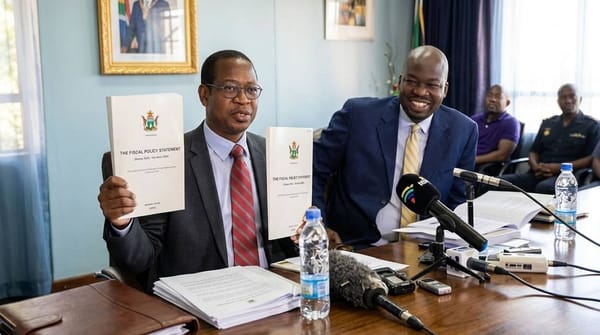
In Zimbabwe, the shock arrived on 4 March when ZERA raised diesel to $1.77 per litre from $1.52 and petrol to $1.71 from $1.56. The calculated prices were $1.90 and $1.81 respectively — the government absorbed the difference by cutting its own levies. That decision did not happen by accident. George Guvamatanga, the Treasury Secretary, has spent four years building a fiscal architecture designed to absorb exactly these kinds of external shocks without printing money or raiding reserves. The fuel subsidy is a quiet signal that the machinery works. But fuel is only the first-order effect. The second-order effect — rising transport costs feeding into food prices, fertiliser shortages hitting the planting season, import bills straining foreign currency reserves — is the Bastiat problem. It is the crisis that arrives three months after the cameras have moved on.
The constructive read is narrow but real. Egypt, Africa's largest fertiliser exporter, sits outside the Hormuz chokepoint and has spare phosphate capacity. Zimbabwe's own agricultural season is already underway, meaning the immediate planting window is less exposed than Kenya's approaching long rains. And the Hormuz crisis has, paradoxically, made the case for African fertiliser production more compelling than any policy paper ever could. Morocco's OCP Group, which controls much of the world's phosphate reserves, and Egypt's production base together represent the foundation of a continental fertiliser supply chain that does not depend on the Gulf. The question is whether African governments will treat this as a strategic wake-up call or simply wait for Hormuz to reopen and return to business as usual.
Bastiat's most famous essay was titled "What Is Seen and What Is Not Seen." He wrote it in 1850. The seen effect of the Hormuz crisis is oil at $100 and queues at the pump. The unseen effect is a fertiliser gap that will quietly reduce African harvests, raise food prices by the fourth quarter of 2026, and push millions of already food-insecure households closer to the edge. The world built a system to respond to oil shocks. It never built a system to respond to fertiliser shocks. Africa, which imports almost everything it spreads on its soil, is paying the price for that oversight right now. The invoice just has not arrived yet.
Until Next Time, Head Bowed.