Three Crises, One Week: A Dynasty Votes Itself Alive, a Rebel Army Gets Sanctioned, and Your Fuel Just Hit $1.77 a Litre
Sassou Nguesso voted himself another five years while his internet died. Washington sanctioned Rwanda’s generals. Zimbabwe’s diesel jumped 16 percent to $1.77 a litre on Middle East strikes. Three stories. One question: who decides?

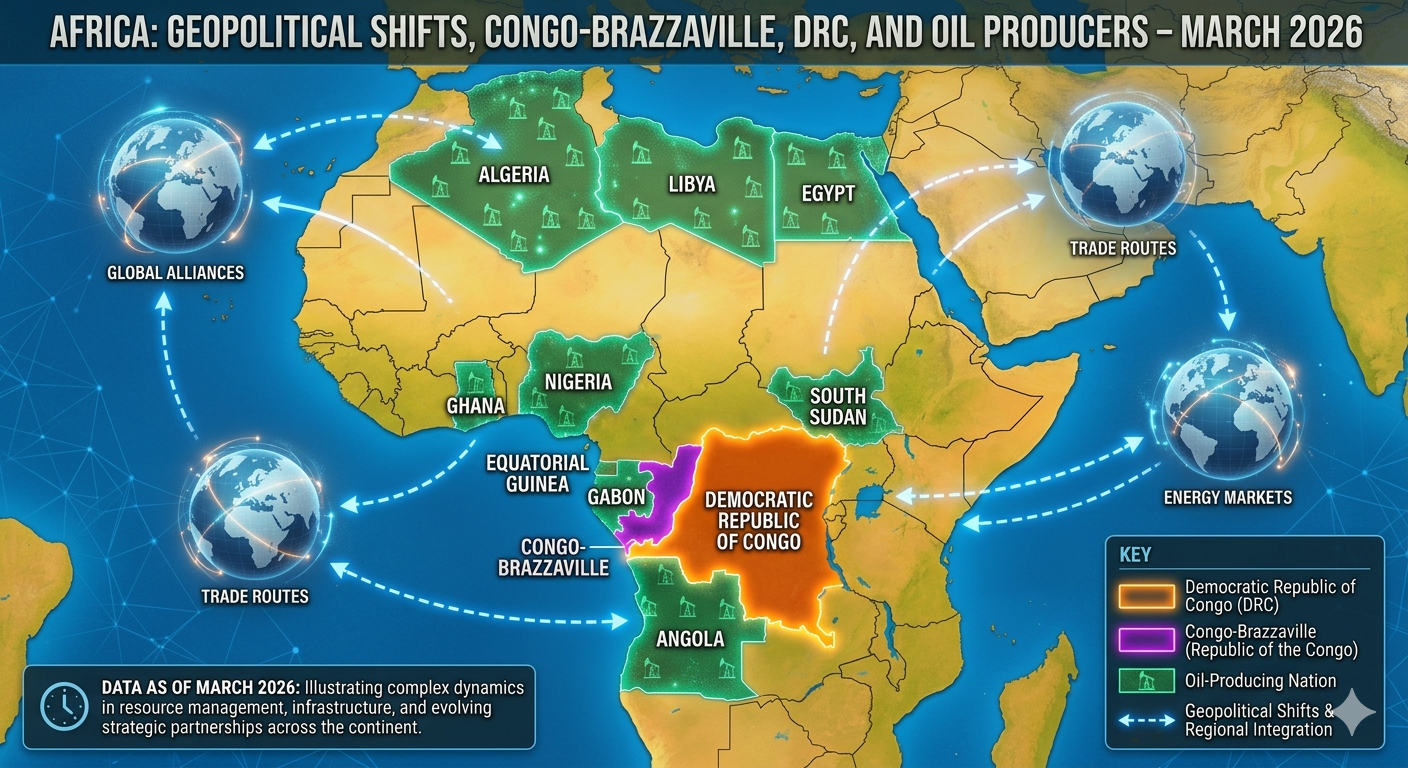
Three things happened in Africa in the last 72 hours that individually would dominate a news cycle. Together, they form a single picture of a continent where sovereignty is being tested from the ballot box, the battlefield, and the pump price simultaneously. None of these stories is about what it appears to be on the surface. All three are about the same thing: who decides.
BRAZZAVILLE: THE DYNASTY THAT VOTES IN THE DARK
On 15 March, the Republic of Congo held a presidential election. Denis Sassou Nguesso, 82 years old and in power for 42 of the last 47 years, faced six opponents that no serious analyst could name without a briefing note. The two main opposition parties boycotted. Two of the country’s most prominent opposition leaders are in prison. Others are in exile. One declared candidate, Lassy Mbouity, was kidnapped in May 2025 and has not been seen since.
As polls opened, the internet went dark. NetBlocks confirmed a nationwide blackout, with connectivity dropping to roughly 3 percent of normal levels. The same tactic was deployed during the 2021 election, when Sassou Nguesso won with 88.4 percent of the vote on a reported 68 percent turnout. This time, analysts expect turnout to fall further. At polling stations in Brazzaville, lines were short or nonexistent.
The election is not the story. The succession is.
Sassou Nguesso’s 50-year-old son, Denis-Christel Sassou-Nguesso, currently serves as Minister of International Cooperation and was recently elected to the National Assembly. He is positioning for the inheritance. But he faces competition from Jean-Dominique Okemba, Secretary General of the National Security Council, and Jean-Jacques Bouya, Minister of State for Regional Development and Sassou Nguesso’s cousin. The daughter holds a presidential advisory role. The family controls multiple nodes of power simultaneously.
Vilfredo Pareto observed over a century ago that elites circulate. The question in Brazzaville is not whether Sassou Nguesso’s grip weakens. It is whether the succession happens inside the family or outside the system entirely. In a country where half the population of 6.1 million lives below the poverty line despite being Africa’s third-largest oil exporter, the gap between the winning coalition and the population it governs has become structurally unsustainable. Freedom House gives the Republic of Congo 17 out of 100 for freedom. The Africa Center for Strategic Studies describes the political system as one where the status quo carries compounding costs on national development. Youth unemployment exceeds 40 percent. The median age signals a population that has known no leader other than the man who just voted himself another five years.
The question for investors with Congo-Brazzaville oil and LNG exposure is not who won. It is what happens when a dynasty built on petroleum rents confronts a succession contest while the population it excludes grows younger, poorer, and more connected than the internet blackout can suppress permanently.
KINSHASA TO WASHINGTON: THE DRC’S TWO-FRONT WAR
While Brazzaville voted in silence, Kinshasa was moving on two fronts.
First, President Felix Tshisekedi signed a decree-law creating a specialised court for economic and financial crimes. The timing is not accidental. Tshisekedi faces mounting pressure over governance failures in the east, a stalled ceasefire process, and an economy where coltan, cobalt, and gold revenues disappear into networks that neither the state nor international monitors can fully trace. The court is a signal to both domestic audiences and international creditors that institutional reform is still on the agenda, even as the eastern provinces remain under rebel control.
Second, and more consequentially, the United States Treasury’s Office of Foreign Assets Control sanctioned the Rwandan military and four of its senior generals for their role in supporting the M23 rebel group. The sanctions name Rwanda’s defence establishment directly, moving beyond the diplomatic euphemism that has characterised Western engagement with Kigali for years. The UN Group of Experts has documented Rwandan military support for M23 repeatedly. Rwanda denies it. Washington has now put a price on that denial.
The M23 seized Goma in January 2025 and Bukavu the following month. Between 900 and 2,000 people were killed in the Goma offensive alone, depending on whether you use UN or Congolese government estimates. The rebel group and its political umbrella, the Alliance Fleuve Congo led by former electoral commission chief Corneille Nangaa, now run parallel administrations in the territories they control. MONUSCO’s acting head, Vivian van de Perre, landed in Goma in February for the first time since the airport fell, meeting directly with AFC-M23 leadership to discuss ceasefire verification mechanisms under the Doha framework.
The ceasefire architecture is layered and fragile. Qatar mediates the Doha process. Angola, under AU Chair Joao Lourenco, proposed a ceasefire effective 18 February. The DRC accepted in principle. The M23 said it was never formally invited to the Angolan track. Both sides accuse the other of violations. On 2 February, Kinshasa accused M23 of a drone attack on Kisangani airport. A French humanitarian worker was killed in a separate drone strike on a civilian neighbourhood in Goma.
The selectorate logic is stark. Kagame’s winning coalition requires control of eastern Congo’s mineral corridor. Tshisekedi’s survival requires demonstrating sovereignty over territory his army cannot hold. Washington’s sanctions shift the cost calculus for Kigali, but only if European capitals follow with their own measures. Brussels is watching. Berlin suspended Rwanda aid negotiations in January 2025 and has not resumed them. London condemned the offensive but has not matched words with financial consequences.
The DRC opened its first gold refinery this week in Kalemie, a move designed to assert state control over a sector where informality and armed-group financing overlap. The refinery is a governance signal, not yet a revenue transformation. But it tells you what Kinshasa is building toward: a state that processes its own minerals rather than watching them cross borders into refineries it does not control.
$1.77 A LITRE: THE PUMP PRICE THAT REWRITES EVERY AFRICAN BUDGET
While two Congos tested the limits of political survival, the price at the pump rewrote household economics across the continent. On 4 March, Zimbabwe’s energy regulator ZERA raised petrol to $1.71 per litre, up from $1.56. Diesel climbed to $1.77, up from $1.52. A 16 percent increase on diesel in a single adjustment. ZERA confirmed that without government cushioning, the actual prices would have been $1.90 for diesel and $1.81 for petrol. The subsidy absorbed the worst of it. The worst of it is still coming.
The trigger is the Iran-US military confrontation, now in its third week. Brent crude has crossed $104 per barrel, the highest since July 2022, after US strikes hit military sites on Kharg Island, which handles roughly 90 percent of Iran’s oil exports. President Trump warned that Iran’s energy infrastructure could face further targeting if Tehran interferes with transit through the Strait of Hormuz. That threat alone moves futures markets. The futures markets move African pump prices within days.
For Africa’s oil exporters, elevated crude is a revenue windfall that arrives at the worst possible political moment. Nigeria, Angola, Congo-Brazzaville, Gabon, and Equatorial Guinea all benefit from higher barrel prices. But the windfall lands in fiscal systems already stretched by debt service, subsidy commitments, and election-year spending pressures. Nigeria’s Dangote refinery is ramping up to meet national demand, and the regulator has halted petrol import licences, reshaping the country’s downstream architecture in real time. Angola’s debt sustainability depends on oil revenue assumptions that current prices exceed by a wide margin, but the benefit accrues to the treasury only if production volumes hold and off-budget spending is contained.
For Africa’s oil importers, the picture inverts. Kenya, Ethiopia, Tanzania, Zimbabwe, Zambia, and the entire East African corridor face fuel price transmission that hits transport costs, food prices, and manufacturing inputs within weeks. Zimbabwe’s 2026 budget was constructed on oil price assumptions that $1.77-a-litre diesel violates. ZERA will review prices again in two weeks. If Brent holds above $100, the next adjustment goes higher. If the government absorbs more through cushioning, the fiscal cost lands on the treasury instead of the motorist, and the budget arithmetic breaks either way. Zambia’s IMF programme was completed in January on a set of macro assumptions that did not price in a sustained Middle East conflict driving energy costs to these levels. Every African central bank running an inflation-targeting framework now faces a supply shock that monetary policy cannot address.
John Maynard Keynes warned that commodity price volatility transmits faster than institutional adjustment. The lag between a Brent spike and its arrival at a Harare fuel station is now measured in days. Petrol was $1.56 on 3 March. It was $1.71 on 4 March. Fifteen cents per litre overnight. That is not an economic statistic. That is a kombi fare increase, a bread price adjustment, and a market vendor recalculating margins before the morning rush. The political consequences arrive on the same schedule.
The Iran-US confrontation also exposes Africa’s infrastructure dependency. Dubai and Doha airports, the continent’s primary transit hubs to Asia and the Gulf, face disruption risk. South Africa has begun evacuating citizens from the Middle East. Kenya’s intelligence service warned in February that over 1,000 Kenyans may have been recruited to fight for Russia in Ukraine under false pretences, a reminder that African labour is already being absorbed into conflicts the continent did not choose.
THE THROUGH LINE
Three crises. One structural truth. Africa’s political stability, security architecture, and fiscal foundations are being tested simultaneously by forces that originate both inside and outside the continent. A dynasty in Brazzaville that governs through exclusion. A rebel army in eastern Congo backed by a neighbouring state that Washington has now formally named. A pump price driven by a Middle Eastern war that no African government can influence but every African household will feel.
The connecting thread is sovereignty. Who decides who governs in Congo-Brazzaville? Who decides who controls eastern DRC’s mineral wealth? Who decides the energy price that determines whether an African family eats this week or next?
The answers are being written this week. Most of Africa’s 1.4 billion people will not see them until the price changes at the pump. In Zimbabwe, that already happened. Fifteen cents per litre. Overnight.
Until next time, Head Bowed.