Why Mnangagwa Removed Chiwenga's Eyes and Ears
Colonel Minnie Baloyi removed from Military Intelligence Directorate. DMI Director Mandaza also removed. Sean Mnangagwa positioned for elevation inside Presidential Guard. Coordinated dismantling of Chiwenga's intelligence access inside the security establishment ahead of 2030.

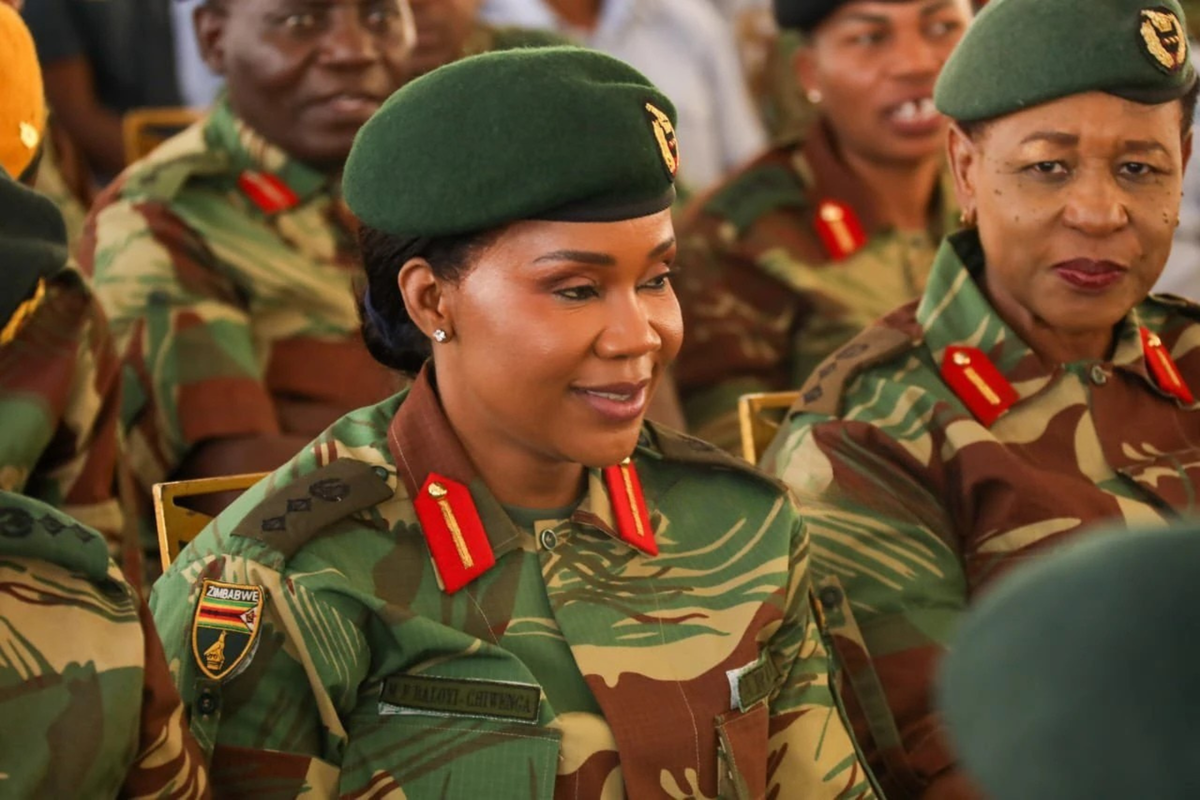
The removal of Colonel Minnie Baloyi from the Military Intelligence Directorate is not a routine rotation. It is the most decisive move in a coordinated restructuring of Zimbabwe's security command that has systematically dismantled Vice President Constantino Chiwenga's access to operational intelligence, military loyalty, and institutional leverage ahead of the 2030 political horizon.
Colonel Miniyothabo Baloyi, the wife of Vice President Constantino Chiwenga, has been removed from her position inside the Military Intelligence Directorate at Zimbabwe Defence Forces headquarters and reassigned to the Commander's Pool, a holding unit with no operational duties and no intelligence access. The reassignment was confirmed by multiple defence sources in the first week of March 2026. In the same period, the Director of Military Intelligence, Mandaza, was also removed from his position. Both moves were executed without public announcement, in line with the Zimbabwe Defence Forces' longstanding practice of operational discretion.
The removals follow the elevation of General Asher Walter Tapfumaneyi to the rank of full General and his installation as Commander of the Zimbabwe National Army in late 2025. Defence sources describe Tapfumaneyi as a direct appointee of President Emmerson Mnangagwa, tasked with securing the military command chain against internal challenge. Reports have also linked Presidential Guard Commander Fidelis Mhonda to a possible elevation to Chief of Staff, and Sean Mnangagwa, the President's son, to a positioning within the Presidential Guard command.
Taken individually, each move can be explained as administrative. Taken together, they constitute a single operation with a single objective: the removal of every officer connected to or loyal to Vice President Chiwenga from positions of operational influence within the defence establishment.
Colonel Baloyi's role was not ceremonial. According to defence sources cited across multiple outlets, she served as a central processing node for intelligence reports flowing from both the Zimbabwe National Army and the Air Force intelligence branches before those reports were escalated to senior command. In practical terms, she occupied a position that determined what information reached the top of the military hierarchy and what did not.
Her marriage to the Vice President gave this role a dual function. It provided Chiwenga with a private channel of information flowing directly from the core of the military intelligence apparatus into his own household. This arrangement was not secret. Former legislator Temba Mliswa publicly stated in a March 1 address that Baloyi had become a conduit for internal military briefings and described her as operating what amounted to a parallel intelligence operation within the directorate. Self-exiled political scientist and former Cabinet minister Jonathan Moyo separately alleged that a senior figure within the security establishment, widely interpreted as a reference to Baloyi, had been leaking classified intelligence for factional political purposes. The accusation gained traction after intelligence reports allegedly revealed details of a trip to Nairobi by Justice Minister Ziyambi Ziyambi, where he reportedly consulted Moyo on constitutional amendment discussions.
The Zimbabwe Defence Forces have not issued an official statement on the reassignment. A senior figure within the Military Intelligence Directorate told ZimEye that Baloyi had overstayed in her position for six years and that the move fell within normal rotational procedures. However, the simultaneous removal of Mandaza and the broader pattern of command restructuring make the administrative explanation difficult to sustain in isolation.
The pattern extends well beyond a single reassignment. Since November 2017, when Chiwenga, then Commander of the Defence Forces, deployed tanks into Harare and facilitated the removal of President Robert Mugabe, the relationship between Mnangagwa and Chiwenga has followed a consistent trajectory: public partnership and private neutralisation.
The military intervention of November 2017 delivered the Presidency to Mnangagwa. Without Chiwenga's decision to act, the transition would not have occurred. But the intervention also created a permanent structural problem for Mnangagwa: the man who gave him power retained the institutional capacity to withdraw it.
Every significant command appointment since 2017 has moved in one direction. Officers associated with Chiwenga have been rotated to non-operational roles. Provincial military deployments have shifted. Intelligence reporting lines have been reorganised. The war veterans' leadership has been realigned. Brigadier General Stanley Mangena was reassigned to non-military duties. Each move followed the same logic: reduce Chiwenga's independent access to the levers of the security establishment without provoking a direct confrontation.
Baloyi's removal represents a qualitative escalation. Previous moves targeted Chiwenga's professional networks. This move entered his household. The signal to the broader defence establishment is unambiguous: proximity to Chiwenga, including personal and familial proximity, no longer provides institutional protection.
The timing is not incidental. Constitutional Amendment Bill No. 3, gazetted on February 16, 2026, proposes to extend the presidential and parliamentary term from five years to seven, effectively postponing the next general election from 2028 to 2030. If the amendment passes, Mnangagwa's timeline in office extends by two additional years.
Those two years are not abstract. They represent two additional years in which the restructuring of the security command can be completed. Two additional years in which every operational position can be filled by a presidential appointee. Two additional years in which Chiwenga's institutional base can be reduced to a title, an office, and a motorcade with no independent capability beneath it.
The military restructuring and the constitutional amendment are not separate initiatives. They operate on the same timeline, serve the same strategic objective, and reinforce each other. The amendment provides the time. The command restructuring fills the time with irreversible institutional change.
The pattern is not unique to Zimbabwe. In Rwanda, following the 1994 military victory that brought Paul Kagame to power, the officers who had fought beside him were among the first to be restructured out of operational command. Patrick Karegeya, who had led external intelligence, was assassinated in Johannesburg in 2014. Kayumba Nyamwasa, a former army chief, survived a shooting in exile. In Uganda, President Yoweri Museveni has rotated military commanders with sufficient frequency to prevent any single officer from building an independent power base. The logic is consistent across every military-assisted political transition on the continent: the soldiers who deliver the palace become the most dangerous variable for the leader they installed.
Mnangagwa observed Robert Mugabe manage this problem for 37 years. He was himself a casualty of the paranoia it produced when Mugabe expelled him from government in November 2017. He is now applying the same institutional logic, with greater precision and less public confrontation, to the man who made his presidency possible.
The question facing Zimbabwe's political establishment is not whether Chiwenga will be removed from office. The evidence suggests the opposite. Chiwenga will retain his title for as long as the title is useful to the Presidency. The question is whether Chiwenga retains any independent institutional capability beneath that title.
As of March 2026, the Military Intelligence Directorate has been decapitated. The ZNA Commander is a presidential appointee. The Presidential Guard is being reinforced with figures linked directly to the Mnangagwa family. The Vice President's wife has been moved to a unit with no operational function.
The architecture of the 2017 coup is being dismantled from the inside, one appointment at a time. The man who delivered the Presidency with tanks is being systematically separated from the institutional machinery that made that delivery possible. Whether this produces the stability the Presidency seeks or the factional tension it is designed to prevent remains the defining question of Zimbabwe's political trajectory through 2030.