BREAKING: New estimates put Zimbabwe near 9% growth
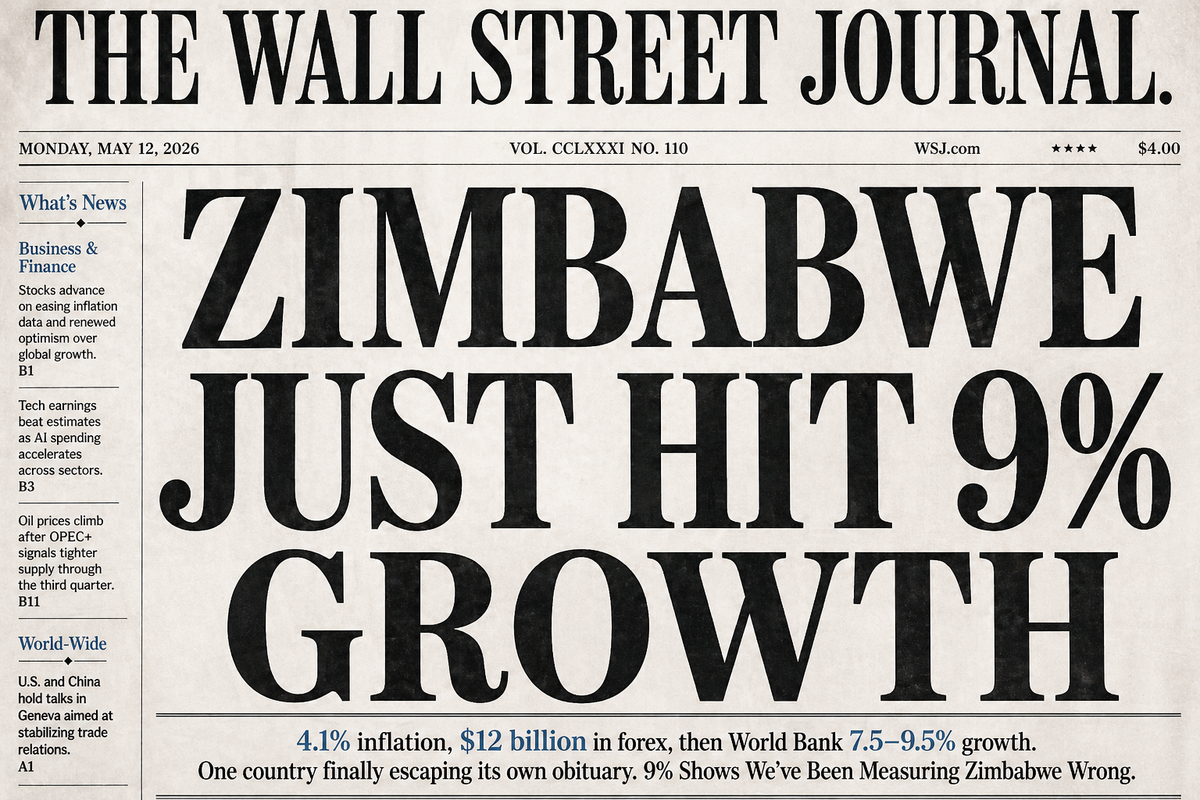
4.1% inflation, $12 billion in forex, then World Bank 7.5–9.5% growth. One country finally escaping its own obituary. 9% Shows We’ve Been Measuring Zimbabwe Wrong

I always felt like something was off each time the Zimbabwe economy numbers where announced. Like what the ywhere reporting and what was in Zimbabwe where not tallying. I see people with money everywhere. This cant possibly be just 5% growth. Not even 6%. There is no way.
In every generation of public life there is a room.
The room has a body. It has appetites. It has favoured authors and discarded ones, approved conclusions, forbidden questions, and a long memory for who agreed with it. Once the room settles on a country, the country becomes a fixture in its furniture. New evidence arrives. The room rearranges the evidence around the verdict it has already published.
It does not refuse the new fact. It reclassifies it. The fact becomes an exception. The exception becomes a footnote. The footnote becomes nothing.
For 18 years, that has been Zimbabwe's problem.
The country was not analysed. It was sentenced.
Then the sentence was repeated until repetition became a substitute for reading.
Zimbabwe became the world's preferred cautionary tale: the one-hundred-trillion-dollar note, the ruined currency, the empty shelves, the collapsed state, the country supposedly proving every warning anyone had ever wanted to issue about African governance, fiscal indiscipline, and monetary collapse.
That story had evidence.
In November 2008, Zimbabwe entered one of the worst monetary collapses ever recorded. Inflation reached numbers that seemed less like economics than astronomy. Prices doubled every 24.7 hours. Savings vanished. Salaries died in queues. A functioning state became a global case study in what happens when money loses the trust of the people forced to use it.
That collapse was real.
Its afterlife was longer than the collapse itself.
The story stayed in circulation after the conditions stopped justifying it, because the story had become more useful than the country.
That was the line everyone saw.
Then the line moved.
By January 2026, annual ZiG inflation had fallen to 4.1%. Foreign-currency inflows reached US$12bn in the first 9 months of 2025. The IMF's April 2026 outlook revised Zimbabwe's 2025 growth upward to 7.5%. Government's own estimate places 2025 growth between 8.5% and 9.5% — among the highest in Africa once South Sudan's 46.1% statistical outlier is removed. The IMF approved a Staff-Monitored Programme in April 2026, reopening a formal path that critics had spent years calling unreachable.
The room barely moved.
A country can revise its inflation, its currency, its arrears strategy, its budget controls, its central-bank discipline, its growth trajectory, and its reengagement with multilaterals — and still not be allowed to revise its reputation. Reputation is not a measurement. It is a service, performed by a class of interpreters whose authority depends on the verdict staying where they last left it.
Zimbabwe's problem is not growth. It is measurement. Too many people became fluent in the old Zimbabwe and forgot to keep watching the country itself.
In December 2023, Eddie Cross warned of a virtually dollarised economy and predicted casualties. In May 2024, Tony Hawkins described the crisis as worse than 2008. In October 2024, Steve Hanke placed Zimbabwe's inflation at 1,266%.
Three voices. One assumption. A country they had stopped remeasuring.
Cross looked for casualties. Single-digit inflation arrived. Hawkins saw no endgame. Reengagement arrived. Hanke printed 1,266%. Reality printed 4.1%.
The old Zimbabwe story did not survive because it remained accurate. It survived because it remained useful.
It gave foreign desks a frame they did not have to rebuild. It gave critics a permanent target. It gave analysts a country they could explain without revisiting. It gave late readers the comfort of sounding informed while saying something already 18 years old. It gave entire careers a steady supply of cautionary material.
Some were no longer measuring Zimbabwe. They were maintaining a version of Zimbabwe that made them sound right.
The country had become an asset class for someone else's authority. As long as it stayed broken in the telling, the tellers stayed credible.
The room was not always lying. It was sometimes just protecting the inventory.
What follows is the part the room has agreed not to read.
Five numbers explain it.
1. 4.1
Zimbabwe's annual ZiG inflation reached 4.1% in January 2026.
For most countries, that would be routine. For Zimbabwe, it is rupture.
This is the country whose currency failure became a global classroom example. The country of the trillion-dollar note. The country whose name became shorthand for monetary ruin. The country described as if every future number had to report back to 2008 before it could be believed.
Then came 4.1%.
Single-digit inflation does not erase the past. It forces the reader back to the evidence.
No country moves from prices doubling every 24.7 hours to single-digit inflation by accident. That move comes from restraint. Controlled spending. Tighter money. A central bank pulled away from excess financing. A Treasury forcing ministries, departments, and agencies back inside the system.
The number is visible. The machinery is harder to see.
The machinery matters more.
PFMS. TSA. Treasury Circular 10. Debt management. Monetary restraint. The Mutapa audit gate. Arrears clearance. NDS2 execution.
Each item sounds administrative. Each item carried a cost the inflation print does not show.
There is no applause for a blocked payment. No headline for delayed spending. No public reward for saying no to people who had grown used to yes.
Every blocked payment had a name on it. Every delayed disbursement had a phone call attached. Every shortcut closed had a shortcut user who lost a year. None of that appears in the inflation print. All of it is inside it.
That is where recovery begins.
The old commentary class understood the spectacle of collapse — the trillion-dollar note, the queue, the panic, the humiliation. It has been slower with the opposite process. Repair rarely announces itself. Repair sounds like a circular. A reconciliation. A payment control. A ledger cleaned. A shortcut closed.
Collapse is cinematic.
Discipline is paperwork.
Countries do not recover because speeches improve. They recover when systems make indiscipline harder.
That is the real story inside 4.1%.
The number looks calm because the fight happened behind it.
2. 60
Roughly 60% of Zimbabwe's economic life sits in the informal sector.
That is why the headline under-reads the country.
The formal economy is the Zimbabwe that reports itself — visible to tax records, bank statements, registered companies, and multilateral comparison tables. It matters. It is real. It is also incomplete.
Beside it sits another Zimbabwe.
Cash-heavy. Dual-currency. Corridor-driven. Informal. Adaptive. Suspicious of paperwork but intimate with value. It trades, builds, remits, supplies, transports, repairs, feeds, imports, exports, and survives at a scale large enough to make the official number true and still insufficient.
Measure Mbare by the stalls inside the building and you miss the pavement where most of the life is happening.
The second economy is not abstract. It is the cross-border trader moving stock before any report can classify the movement. The builder paid in cash before a permit catches up. The small-scale miner whose output travels through channels too fragmented for clean national accounting. The remittance-funded household converting US$200 from Johannesburg into school fees, groceries, airtime, rent, transport, and inventory before the banking system has finished blinking.
It is the kombi operator. The mechanic. The market vendor. The diaspora corridor functioning as a private balance-of-payments stabiliser. The family network operating as a credit system that no bank built and no regulator approved.
A model that misses them misses the country.
Partial data is not worthless. It becomes dangerous only when it is treated as the whole and wrapped in the confidence of a final verdict.
The old model wants Zimbabwe to behave like a tidy country.
Zimbabwe has spent 2 decades doing something more difficult.
It adapted.
Analysts who cannot measure adaptation will keep mistaking movement for disorder.
3. 12
Zimbabwe recorded an estimated US$12bn in foreign-currency inflows in the first 9 months of 2025.
That is the quiet number.
It may also be the most revealing.
Foreign currency is the bloodstream of the real economy — exports, mining receipts, diaspora remittances, tourism, cross-border trade, private settlement networks, informal corridors. None of it sits neatly inside one national account.
In Zimbabwe it is not technical. It is central.
The dollar moves first. The report arrives later.
That delay is where value disappears from the official frame.
US$12bn in 9 months means something is alive beneath the surface. It means diaspora money has moved beyond family support and into capital formation. It pays fees, buys stock, builds homes, finances trade, anchors consumption.
It is the country's private balance sheet, operated by people the official accounts do not list.
Mining is not a sectoral line. It is a foreign-currency engine. Exports are not a statistic. They are the bridge between a formally constrained state and a privately adaptive country.
The outside world keeps asking whether Zimbabwe has money moving.
The Budget already answered.
The better question is whether analysts are prepared to follow the money into the places where it actually moves.
The old reading waits for recovery to appear in clean formal channels — as if a country shaped by distrust would first ask permission from official measurement before value began to circulate.
Zimbabwe's recovery is not waiting at the front desk.
It is in the flow.
4. 7.5
The IMF's April 2026 outlook revised Zimbabwe's 2025 growth upward to 7.5%.
The room received the number the way a court receives evidence it had hoped would not arrive: politely, briefly, and without reorganising its file.
Read what is actually in front of the room.
The IMF's April 2026 print is the closest the world's measurement has come to reading Zimbabwe honestly in 18 years. It is not the whole picture. The 7.5% still under-counts the second economy. Government's 8.5%–9.5% reading does the work of restoring the country to the data. But for the first time in nearly two decades, the official line on paper has started resembling the country people walk through every day.
The construction. The commerce. The capital formation. The dollar density in the parts of the economy nobody bothered to formalise. The diaspora corridors. The private settlement networks. The expansion visible in suburbs and small towns and corridor markets that the old vocabulary refused to call growth.
The two stories — the one printed in Washington and the one lived in Harare — have started arriving in the same place.
That is the real meaning of 7.5%.
The 2026 Budget then projects 5% growth on top of that base. The drivers are visible — agriculture, mining, commodity prices, and the disciplined macroeconomic coordination the chamber had been treating as either impossible or insincere.
This is not a collapse profile.
It is recovery.
It is recovery inside a country whose old reputation makes every positive number fight harder than it should.
Recovery does not just expand. It reclassifies. Activity that had fled formality begins to return. Arrears clearance restores supplier confidence. Currency stability resets pricing behaviour. Debt engagement reshapes risk. Spending control changes how the state is read by every business waiting to be paid.
Growth here is production.
It is also return.
Return of activity to formal accounts. Return of creditors to the table. Return of trust in local money. Return of a government balance sheet that can be read without guessing what sits behind the curtain.
The architecture matters.
The Public Finance Management System. The Treasury Single Account. The Expenditure Arrears Clearance Strategy 2026–2030, signed at Treasury in November 2025. The Mutapa Investment Fund audit gate. Treasury Circular 10. Debt management. Monetary discipline. NDS2 execution.
These are not headlines.
They are pipes.
When the pipes stop leaking, the house eventually stops flooding.
The comparison the room avoids belongs in the same paragraph. Zimbabwe at 7.5% sits far above South Africa, Nigeria, Kenya, Ghana, Côte d'Ivoire, Rwanda, Uganda, and the broader emerging-market average. Read both economies honestly and the country sits in the same conversation as Ethiopia at the very top of the African table.
The comparison was not absent by accident. It would be inconvenient.
South Africa's stagnation has writers. Nigeria's currency pain has writers. Ghana's recovery has writers. Zimbabwe is permitted commentators but not a comparison class.
South Africa's stagnation is treated as a structural challenge. Nigeria's currency pain is treated as reform turbulence. Ghana's recovery is treated as a macroeconomic cycle. Zimbabwe's growth is treated as a suspicious exception.
That framing is editorial. It is not economic.
A country growing far above the regional average while rebuilding monetary credibility cannot be read through collapse language forever.
At some point, the old vocabulary becomes the new error.
The Work Nobody Claps For
Collapse is easy to write. Repair is harder to watch.
A broken currency gives the world a symbol. A repaired payment system gives it a footnote. A trillion-dollar note can travel the world in a photograph. A blocked payment dies silently inside an office file.
States are not rebuilt in symbols.
They are rebuilt in controls.
A payment blocked. A ministry delayed. A supplier told to wait. A politically connected appetite denied. A ledger reconciled. A shortcut closed.
That is where recovery begins.
Not in the speech.
In the refusal.
The most difficult reforms are rarely the ones announced at podiums. They are the ones enforced in rooms where nobody claps and everyone remembers who said no.
Some careers ended in those rooms. Some appetites lost their patron. Some networks discovered the state had stopped being negotiable. None of that is in the public number. All of it is inside it.
Every system that now looks technical once had to defeat a habit. Every discipline now described as policy once had to confront a person who benefited from disorder.
PFMS is not just software. It is memory with consequences.
The Treasury Single Account is not just banking architecture. It is the end of splintered ledgers.
Arrears clearance is not just a repayment schedule. It is a signal to the market that the state intends to become readable again.
Treasury Circular 10 is not just a circular. It is a gate where appetite now meets authority.
The chamber rarely understands this. It sees a number and asks whether it is credible. It does not ask what had to be killed quietly for that number to exist.
The reformer is attacked in the present tense.
History apologises in the past tense.
Zimbabwe is now entering that interval.
5. 1,266
The fifth number belongs to Steve Hanke.
In October 2024, his dashboard placed Zimbabwe's inflation at 1,266%.
Hanke has been one of the most-cited international voices on Zimbabwean inflation for years. The dashboard supplied the fast line, the convenient quote, the ready-made graphic, and the external authority for a global press corps trained to treat Zimbabwean monetary claims with suspicion.
The dashboard became more than a data point. It became a credentialing device — a way for the room to recognise itself.
Its most loyal users were not Zimbabweans. They were people in other rooms whose authority depended on having a Zimbabwe to point at. They needed a number. They did not need it to be true.
That authority now has a measurement problem.
Zimbabwe earned scrutiny. 2008 remains valid memory. The failures of local currency reform remain valid memory. Scepticism has a place. So does discipline.
Measurement must still measure.
Hanke's problem was never confidence. It was fit.
He brought a loud instrument to a complicated country and mistook the noise for precision.
A thermometer reading 1,266 when the patient is at 4.1 is no longer measuring fever. It is exposing the instrument.
The first problem is method. The dashboard leans on purchasing-power-parity assumptions applied to volatile exchange signals. J. Atsu Amegashie's critique goes to the foundation: the model assumes PPP holds before proving that it does. In a dual-currency, informal, adaptive economy, one signal cannot stand in for the whole country.
That confuses confidence with evidence.
The second problem is fit. Zimbabwe is not a clean one-currency laboratory. It is a cash-adaptive economy where official rates, parallel rates, remittance behaviour, USD settlement, ZiG accounting, and informal pricing can move through the same week without telling the same story.
The question is no longer whether Zimbabwe fits the dashboard.
The question is whether the dashboard ever fitted Zimbabwe.
The third problem is consequence. For years, the model did not stay on a dashboard. It travelled. Into boardrooms. Into investor calls. Into embassy notes. Into risk memos. Into headlines. Into speeches. Into the casual confidence of people who had stopped reading the country and started reading each other.
It became a permission structure for people who had already decided Zimbabwe was not worth remeasuring.
The cost did not stay on the dashboard.
It travelled to the credit committee that priced Zimbabwean debt off a phantom inflation reading. To the investor who walked away from a mining stake because a model said the currency was already gone. To the bank that closed a corridor account in case the headline was right. To the exporter denied a credit line because a tweet had reached the room before the central bank's report did. To the Zimbabwean working in Johannesburg who spent another year explaining that the country she sends money to is not the country in the dashboard.
A country can survive bad commentary.
It pays a higher price when bad measurement becomes respectable commentary.
At 1,266%, the dashboard did not merely miss the number. It revealed the danger of a model that had become too famous to be questioned by the people quoting it.
A model that reads 1,266 against a printed 4.1 had reached its verdict before the country had finished presenting the evidence.
That is the indictment.
No insult required.
What The Five Numbers Reveal
4.1. 60. 12. 7.5. 1,266.
Each number tells its own story. Together they point to one conclusion: Zimbabwe is being under-read by a room that became too comfortable with its old answer.
Cross said casualties. Casualties never came. Single-digit inflation arrived for the first time in more than 3 decades.
Hawkins saw no reengagement. The IMF approved a Staff-Monitored Programme in April 2026.
Hanke printed 1,266%. Reality printed 4.1%. The instrument now stands exposed.
Then the IMF printed the verdict the room spent years treating as impossible: Zimbabwe at 7.5%, near the top of the African growth table once Sudan's distortion is set aside.
Treasury read the movement before the multilateral table was ready to name it.
The failure of the chamber was not malice. It was smaller than that.
It was habit.
The habit of using 2008 as a measuring instrument. The habit of treating every new number as a temporary exception. The habit of confusing old fluency with current knowledge.
Zimbabwe changed.
The room kept performing expertise.
An expertise that no longer requires reading the country was always going to outlast the country it claims to read.
The Re-Formalisation Decade
Zimbabwe did not stop working. It migrated.
For 2 decades, activity moved outside the formal system because the formal system could not always protect value. People did not wait for permission to survive. They built around distrust. Cash. USD. Informal trade. Cross-border supply chains. Family networks. Diaspora corridors. Mobile money. Barter. Private settlement.
Since 2018, Treasury's deeper task has been to make the formal system competitive enough to pull that activity back.
That is the re-formalisation decade.
The 7.5% IMF print is what re-formalisation looks like in the data the world watches. The 8.5%–9.5% Government reading is what it looks like when both economies are counted.
One is the floor.
The other is the country.
Zimbabwe is moving between them.
The next decade matters more than the last headline. If the state keeps discipline, if arrears clearance holds, if monetary restraint survives pressure, if PFMS and TSA keep closing the old paths, if the formal system becomes faster, cleaner, and more credible than the informal workaround, then the numbers will keep embarrassing the old story.
Not because the country became easy.
Because the country stopped negotiating with the old frame.
The frame lost its leverage.
The country stopped requesting its blessing.
The Recognition Lag
Data moves first.
Narratives follow.
Zimbabwe in 2026 sits in that gap.
Some readings of Zimbabwe were never going to update quickly because too many reputations had been built on the country remaining a cautionary tale.
The country changed faster than the people paid to interpret it.
South Korea lived inside that lag. Vietnam lived inside it. Rwanda lived inside it. Each country also had a chamber. Each chamber arrived late.
The pattern is structural. First the data moves. Then insiders notice. Then outsiders deny. Then capital quietly adjusts. Then the press arrives late and writes as if the shift had always been obvious.
The room never apologises. It simply stops mentioning what it used to insist.
Zimbabwe is now in that interval.
The chamber commented for 2 decades.
Treasury built for 8 years.
The IMF, in April 2026, finally reported the difference.
Treasury was first.
The IMF caught up.
The room is welcome to its old answer.
Zimbabwe has moved on.
The line has changed.
The only question left is who still needs the old answer to feel informed.
Until Next Time, Head Bowed.