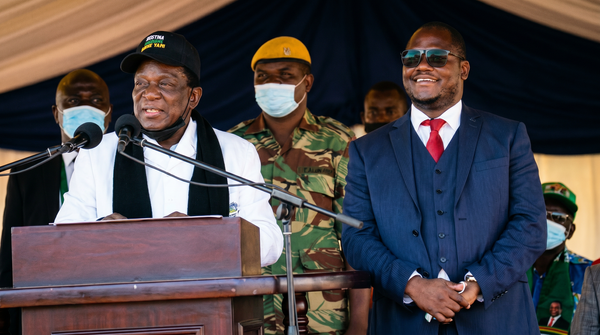
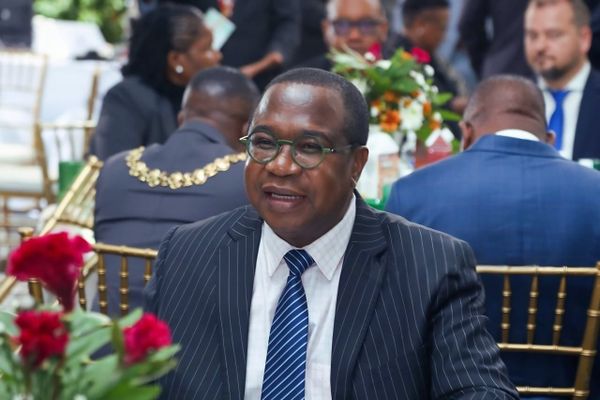
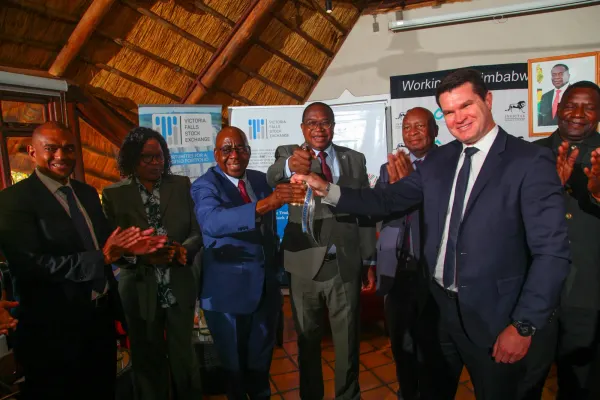
How Mthuli Ncube Kept His Promise
And the technocrat beside him who made sure the ledgers matched the words.

Washington. 16 April 2026. A building most Zimbabweans have never entered. A committee most ministers will never address. A decision most African treasuries have waited a full generation for and never received.
That morning, IMF Management approved a 10-month Staff Monitored Programme for Zimbabwe.
It happened quietly. No cameras. No rolling press conference on ZBC. A brief statement on the IMF website, dated and filed. In Harare, two phones lit up. One belonged to the Minister of Finance. The other belonged to his Permanent Secretary.
Two Men, One Invitation, Eight Years
The invitation Mthuli Ncube accepted in September 2018 was the kind most economists of his stature decline. He was Chief Economist at the African Development Bank. He had the Oxford chair, the global citations, the Geneva-to-Washington network. He did not need Zimbabwe. Zimbabwe needed him.
He took the job anyway.
In the same month, across the city, a commercial banker named George Guvamatanga walked out of the Chief Executive's office at Barclays Bank Zimbabwe and into Treasury as Permanent Secretary. A banker turning down the private sector to run a bankrupt fiscus. Two appointments, one week, one mandate — repair a ministry that had not completed an IMF programme since the 1990s, had not produced a primary surplus in a generation, and had accumulated roughly seven and a half billion United States dollars in arrears to international financial institutions.
Eight years later, on 16 April 2026, the IMF told them they had done it.
What the Fund approved last week was not simply a policy document. It was a verdict on the rarest asset in African governance — a Minister and a Permanent Secretary who held their discipline for eight straight fiscal years without internal fracture.
The Architect and The Operator
The partnership worked because both men understood the division of labour.
Mthuli Ncube was the architect. The Transitional Stabilisation Programme of 2018. The National Development Strategy 1 of 2021. The National Development Strategy 2 of 2025. The currency reset that produced the ZiG in April 2024. The 2024, 2025, and 2026 Budgets. The tax reform programme. The public appearances at Bretton Woods, the IMF Spring Meetings, the African Caucus. The intellectual and political credibility needed to walk into a room of IMF executive directors and have his argument taken seriously before he opened his mouth.
George Guvamatanga was the operator. The Public Finance Management System migration. The Treasury Circulars that locked down off-budget spending. The Arrears Validation Taskforce that forensically sorted tens of billions in unvalidated claims. The Paymaster-General authority that reasserted central cash control across every ministry. The quiet work of forcing Ministries, Departments and Agencies back inside a single accounting architecture after two decades of parallel systems.
Ministers without operators produce speeches. Operators without ministers produce memos no one signs. Zimbabwe had both, in position, simultaneously, for eight consecutive fiscal years. That is not common in Africa. It is not common in the world.
What Discipline Actually Costs
The numbers that built the 16 April approval were not glamorous. They never are.
The budget deficit narrowed from chaotic multi-year gaps down to 2.1 percent of GDP in 2022, 2.0 percent in 2023, and 1.2 percent in 2024. By 2025 the fiscus produced a primary surplus — revenue exceeded non-interest spending for the first time in a generation. ZIMRA overshot its 2024 revenue target by more than ten percent. Annual domestic currency inflation fell to 4.1 percent in January 2026 and stayed inside single digits through March. Foreign reserves climbed to approximately 1.2 billion United States dollars by end 2025. Growth strengthened to 6.6 percent in 2025, the country's strongest print in fourteen years.
Each of those numbers is a hundred unphotographed decisions. The Minister set the policy frame. The Permanent Secretary enforced the ledger. Neither number appears on a billboard. Neither decision gets celebrated on a talk show. Discipline is not a press conference. Discipline is a circular no one forwards.
What is striking about the 2026 position is not any single data point. It is that all of them moved in the same direction at the same time. That is not luck. That is a ministry.
The 2019 Failure and The 2026 Win
The most underrated quote of this cycle came from the Permanent Secretary, speaking at the close of the IMF mission on 6 February. George Guvamatanga said plainly — "In the past, we tried to implement this amidst droughts, cyclones and immediately post-Covid. In hindsight, that timing was very wrong."
Read that sentence twice.
It would be unremarkable coming from a Swiss finance ministry. Coming from Harare it is historic. It is self-correcting. It accepts that the 2019 SMP did not fail because of a sanctions conspiracy, or a hostile Fund, or saboteurs inside the building. It failed because macro conditions were not ready, and some of those conditions Treasury itself had underestimated. The culture of learning shows in the record. The record shows it again this cycle.
The Minister put the same thought in a different register. At the conclusion of the mission, Mthuli Ncube said — "There is nothing in the policy matrix that is not in our budget or not in the NDS2. These are our own policies in the first place."
That is a sovereignty statement. It is also a declaration that the programme is not something being done to Zimbabwe. It is something being done by Zimbabwe. The IMF confirms. It does not design.
The 2026 programme arrives with three structural conditions the 2019 programme did not have — a completed currency reset, a primary fiscal surplus, and single-digit inflation sustained across three quarters. In May 2019 none of those three existed. All three exist today. That is not narrative. That is arithmetic.
What Was Settled With Maliszewski
The IMF mission led by Wojciech Maliszewski sat in Harare from 28 January to 6 February 2026. What emerged and survived Management review was a 10-month programme built around four commitments already living inside Zimbabwe's own 2026 Budget and NDS2.
Prudent budget execution anchored to a conservative revenue outlook for the first half of the year. Sustained monetary discipline by the Reserve Bank. Reinforced domestic arrears monitoring with regular reporting and clearer institutional ownership. Improved cash planning and short-term liquidity forecasting. Over the programme horizon, the structural move to a Treasury Single Account and an accrual-basis International Public Sector Accounting Standards migration that most African ministries have been promising for fifteen years and delivering for none.
Observe what is not on that list. No demand for austerity theatre. No punitive subsidy removal shoved down a population. No currency regime imposed from Washington. The Minister authored the architecture. The Permanent Secretary will enforce it. The Fund will review it quarterly. That is exactly what an SMP is supposed to look like when a country has done its homework.
A country acquires credibility the day its reform programme stops being something done to it and starts being something done by it. Zimbabwe crossed that line in February. The 16 April approval notarised the crossing.
Why This Matters Beyond Zimbabwe
African finance ministries are watching closely. The continent has an arrears problem that is no longer theoretical. Ghana restructured under the G20 Common Framework. Zambia restructured. Ethiopia is mid-process. Kenya is walking the edge. Every African Finance Permanent Secretary I have spoken to in the last six months has asked a version of the same question — is the re-engagement pathway actually open, or is it a mirage?
On 16 April, part of the answer arrived. The pathway is open. It is narrow. It requires a Minister-PS partnership most African treasuries have not built. But it exists.
Zimbabwe will now move into the second phase of the Arrears Clearance and Debt Resolution Roadmap. A bilateral champion for the bridge loan needed to clear IFI arrears. Agreements with the Paris Club. Agreements with commercial creditors. An eligibility review for an Upper Credit Tranche programme with the Fund. None of it trivial. None of it guaranteed.
But precedent compounds. The country that walked in from the cold last week has built the single most portable asset in international finance — a reform record. Reform records get quoted in the next round of negotiations. They anchor sovereign risk premia. They open bilateral doors. They sit inside Morgan Stanley emerging-market notes. They follow the country for years after the circular that produced them has been filed away.
The Objections, Answered Honestly
The sceptics will say an SMP is not a loan. Correct. It is not meant to be. It is the credential that unlocks the loan.
They will point at the 2019 collapse. Fair. But the 2019 programme did not have a primary surplus, a completed currency reset, or single-digit inflation. The 2026 programme has all three before the first review.
They will say Zimbabwe has had moments like this before and squandered them. Also fair. History earned that scepticism. The only answer to earned scepticism is the next twelve months of quarterly reviews. Treasury has passed every milestone it set for itself since 2022. There is no reason to assume a collapse this cycle that did not announce itself in the last four fiscal years of data.
Healthy scepticism is a citizen's duty. Reflexive scepticism, after eight years of documented discipline from both the Minister and his Permanent Secretary, becomes something else.
The Promise Kept
The cameras were never going to be at the IMF on 16 April. That is the point. Real fiscal rebuilding does not photograph well. It does not trend. It lives in Budget Statements that ministers read at lunchtime and Treasury Circulars that no one forwards.
When historians write the chapter on the year Zimbabwe walked back to the table, they will look for a moment. A signing. A flashbulb. A marble-step handshake in Washington. They will not find one.
They will find Mthuli Ncube's signature at the bottom of the 2026 National Budget Statement. They will find George Guvamatanga's signature on the Treasury Circulars that enforced it. Two names. One ministry. One result.
Both men made a promise to this country in September 2018. Last week the International Monetary Fund confirmed, in writing, that they kept it.
That is enough.
The Lumumba Files — 9 PM, weekdays. Acie Lumumba on Zimbabwe's political architecture, the selectorate theory of African power, and the quiet technocrats who actually run governments.
END