Why GDP Numbers Are Hiding Zimbabwe's Real Data
Zimbabwe Doesn't Have an Economy Problem. It Has a Measurement Problem.

In December 2023, Eddie Cross warned Zimbabwe was “virtually dollarized” and predicted casualties.
In May 2024, Tony Hawkins called the crisis “worse than 2008”.
In October 2025, Steve Hanke put inflation at 1,266%.
Three voices. Same conclusion.
All wrong.
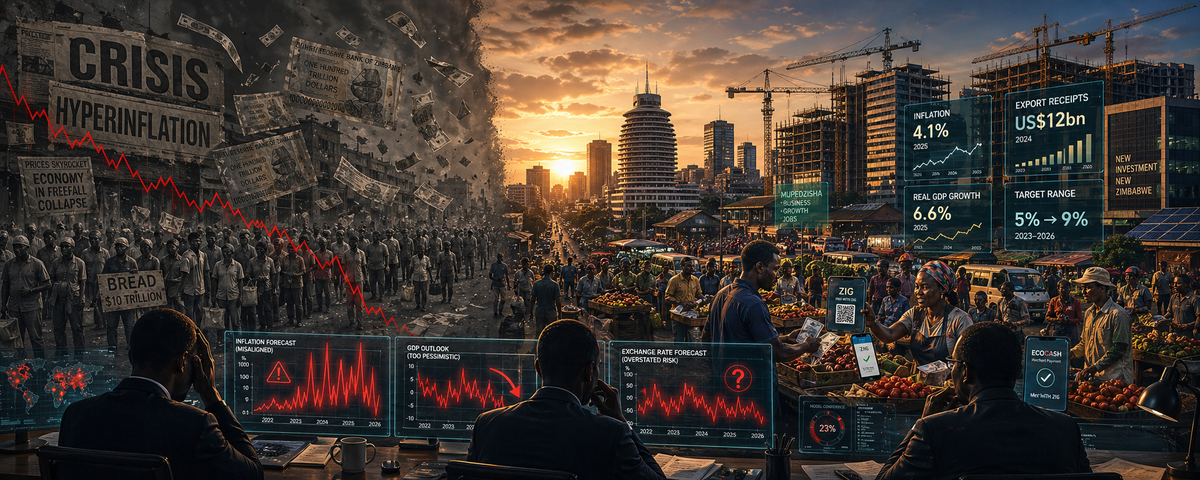
By January 2026, ZiG inflation was 4.1%. Foreign-currency inflows hit US$12 billion (first nine months of 2025). Growth was revised to 6.6%. The IMF approved a Staff-Monitored Programme in April 2026 — the reengagement Hawkins said wasn’t coming.
Cross predicted casualties. The course changed.
Hawkins saw no endgame. Reengagement arrived.
Hanke said 1,266%. The system printed 4.1%.
Hanke missed by 308x.
For two decades, Zimbabwe has been filtered through a tight chamber of confident conclusions — amplified, cited, and priced into global risk.
That chamber has also been repeatedly wrong.
This is not a defence of policy.
It is an audit of the people who claim to measure it.
The Country The Chamber Stopped Watching
In November 2008, Zimbabwe hit one of the worst monetary collapses ever recorded: inflation at 79.6 billion percent, prices doubling every 24.7 hours, and trillion-dollar notes chasing empty value. Savings vanished. Salaries expired in queues. A functioning state became a global case study in collapse.
That is not today’s Zimbabwe.
The official 5% growth for 2026 is credible—but incomplete. It captures what is visible: formal firms, taxed activity, banked flows, ZiG output.
The real economy is larger.
It runs on two currencies, two systems, and two realities: the recorded economy, and the one that adapts beyond it.
Read both—and growth trends closer to 9% than 5%.
The 9% reading is not a guess. It is arithmetic the chamber avoids.
Start with what is undisputed: 5% formal growth in 2026, after 6.6% in 2025.
Add what is also undisputed: ~60% of economic activity sits in the informal sector.
Add the RBZ’s own signal: US$12 billion in foreign-currency inflows in the first nine months of 2025—much of it circulating outside formal GDP capture.
Now do the obvious maths.
If even a conservative share of that informal activity and those flows convert into output, growth does not sit at 5%. It moves toward 8–9.5%.
No politics. Just counting both economies.
Two Systems, One Country
Zimbabwe has lived inside two systems for two decades — one on paper, one in motion.
When Treasury reports 5% growth, it is not understating. It is reporting accurately on the economy it can properly count. There is another Zimbabwe: cash-heavy, informal, dual-currency, corridor-driven, and adaptive. It trades, builds, remits, supplies, and survives at a scale large enough to make the official numbers true and still incomplete.
The global narrative stayed locked in 2008 because collapse is an easy story to repeat. Recovery is quieter. It hides in administrative plumbing — arrears strategy, spending control, monetary restraint, systems that make indiscipline harder.
Zimbabwe has been rebuilding the boring machinery that makes a state legible again — cash control, arrears clean-up, tighter money, spending discipline, payment systems, enforcement.
When Treasury reports 5% growth, treat it seriously.
Then do the next serious thing: admit what the number cannot fully see.
Five numbers explain the gap.
1. 4.1
Zimbabwe’s annual ZiG inflation hit 4.1% in January 2026.
For most countries, that’s routine. For Zimbabwe, it’s rupture.
This is the country of the trillion-dollar note, where 79.6 billion percent inflation became shorthand for failure. A number repeated so often it drowned out new evidence.
4.1% is that evidence.
Single-digit inflation doesn’t erase the past. It forces a return to discipline.
This didn’t happen by accident. It came from restraint: controlled spending, tighter money, a central bank that stopped financing excess, and a Treasury that kept ministries inside the system.
The number is visible. The machinery is not—and it matters more.
Public finance controls. A unified Treasury account. Debt discipline. Monetary restraint. No applause for blocked payments. No headlines for delayed spending. No reward for saying no.
But recovery isn’t spectacle. It’s systems that make indiscipline harder.
That is the real story inside 4.1%.
2. 60
Roughly 60% of Zimbabwe’s economic life sits in the informal sector.
That is where the 5% headline under-reads the country. It captures what reports itself, not what survives uncounted.
Measure Mbare by the stalls inside the building and you miss the pavement where most trade happens.
The same error applies here: the number is technically correct; the story is not.
This second economy is not abstract. It is cross-border traders, cash-paid builders, small-scale miners, remittance-driven households, and the service and transport networks that keep demand moving.
Official data is not wrong. It is partial. The mistake is treating the formal economy as the whole.
Analysts who cannot measure the adaptation will keep mistaking movement for disorder.
3. 12
Zimbabwe recorded an estimated US$12 billion in foreign-currency inflows in the first nine months of 2025.
That is the quiet number.
It may also be the most revealing.
Foreign currency is the bloodstream of the real Zimbabwean economy. It enters through exports, mining receipts, diaspora remittances, tourism, cross-border trade, and private settlement networks that never sit neatly inside one national account.
The dollar moves first.
The report arrives later.
That delay is where value disappears from the official frame.
US$12 billion in nine months means something is alive beneath the surface.
It means diaspora money is doing more than supporting families. It is capitalising trade. It is paying fees. It is building homes. It is moving stock. It is anchoring consumption. It is underwriting the quiet private economy that keeps Zimbabwe functioning between policy cycles.
The outside world keeps asking whether Zimbabwe has money moving.
The better question is whether analysts are prepared to follow the money into the places where it actually moves.
4. 6.6
Zimbabwe revised 2025 growth to 6.6%.
The 2026 Budget projects 5% growth after that rebound—driven by agriculture, mining, better rainfall, firmer commodity prices, and tighter macro coordination.
This is not a collapse profile.
It is recovery.
Recovery economies don’t just expand—they reclassify. Activity returns to formal channels. Arrears clearance restores supplier confidence. Currency stability resets pricing. Debt engagement reshapes risk. Spending control changes how the state is trusted.
Growth here is not just production.
It is return.
Return of activity to formal accounts.
Return of creditors to the table.
Return of trust in local money.
The architecture is already in place: PFMS, TSA, arrears clearance (2026–2030), Mutapa audit gate, Treasury Circular 10, debt management, monetary discipline, NDS2 execution.
These are not headlines.
They are pipes.
And recovery does not come from better speeches. It comes when the pipes stop leaking.
The Comparison Nobody Made
There is a comparison the chamber has avoided for years.
The IMF's Regional Economic Outlook for Sub-Saharan Africa places the regional growth average for 2026 at 2.9%. South Africa is projected at 1.4%. Nigeria, working through its own currency consolidation, at 3.2%. Egypt at 4.0%. Ethiopia, off a higher base, at 6.2%.
The continental peers Zimbabwe is most often compared to in international press coverage are growing significantly slower than Zimbabwe is.
Globally, the picture is the same. The IMF's emerging-market and developing-economy growth average for 2026 is 4.3%. The United States is projected at 1.9%. The Eurozone at 1.2%. China at 4.4%.
Zimbabwe's headline 5% already places it ahead of the emerging-market average. It places it ahead of every major developed economy. The 9% honest reading places it among the fastest-growing economies in the world.
This is the comparison the international press has not made. When a Reuters Zimbabwe story runs, it does not contextualise the country's growth rate against South Africa's 1.4% or the Eurozone's 1.2%. It runs a stand-alone piece that frames Zimbabwe as struggling without anchoring the framing in any peer comparison.
That framing is editorial. It is not economic.
A country growing at twice the regional average and ahead of most of the developed world is not a country in collapse. The chamber has been describing one Zimbabwe while another Zimbabwe outperforms half the planet.
5. 1,266
The fifth number belongs to Steve Hanke.
In October 2024, his dashboard placed Zimbabwe’s inflation at 1,266%.
A thermometer reading 1,266 when the patient is at 4.1 is no longer measuring fever.
It is exposing the instrument.
Zimbabwe earned scepticism—2008, 2019, 2020 remain valid memory.
But measurement must still measure.
First problem: method.
Hanke’s model leans on PPP assumptions applied to volatile exchange signals.
As J. Atsu Amegashie argues, it assumes PPP holds before proving it does.
In a dual-currency, informal, adaptive economy, one signal cannot stand in for the whole.
That confuses confidence with evidence.
Second problem: fit.
The question is no longer whether Zimbabwe fits the dashboard—but whether the dashboard ever fit Zimbabwe.
Third problem: consequence.
For years, the model supplied the headline: inflation as permanent crisis.
It shaped commentary, delayed recognition of change, and locked analysis in 2008.
What The Five Numbers Reveal
Each number tells its own story. Together, they point to one conclusion.
Cross forecast permanent dollarisation and casualties. The casualties never came. The reversal did—single-digit inflation for the first time in three decades.
Hawkins called a crisis worse than 2008 with no path to reengagement. Recovery now exceeds any point since 2008.
Hanke printed 1,266%. Reality printed 4.1%.
The Re-Formalisation Decade
Zimbabwe did not collapse. It migrated. For two decades, activity moved outside the formal system as governance failed. People did not stop working. Since 2018, Treasury’s task has been simple: make the formal system competitive enough to pull activity back.
This decade is re-formalisation.
The Recognition Lag
Data moves first. Narratives follow.
Zimbabwe in 2026 sits in that gap. Until next time—head bowed.